


By Rodger Dean Duncan
Will your change initiative succeed or fail?
The 10-minute assessment that reveals your organization’s true change-readiness, even if it seems like everyone’s on board. Take the assessment here.
Some things in life are simply indisputable. One of those things is that mindset matters.
Stanford University professor Carol Dweck puts it this way: “You try something, it doesn’t work, and maybe people even criticize you. In a fixed mindset, you say, ‘I tried this, it’s over.’ In a growth mindset, you look for what you’ve learned.”
History is blooming with people who overcame obstacles with a growth mindset. Consider Thomas Edison, Nelson Mandela, Rosa Parks, Michael Jordan, Amelia Earhart, Steve Jobs, Maya Angelou. And, of course, brainiac Albert Einstein.
Most of us will never be famous, but all of us can benefit from adopting a growth mindset.
That’s the view of Guy Kawasaki. He’s interviewed more than 200 extraordinary people who have used a growth mindset to overcome obstacles in producing exceptional achievements. He shares many insights from that research in Think Remarkable: 9 Paths to Transform Your Life and Make a Diffference.
This is not a typical self-help, dare-to-be-great book. It’s a well-researched call-to-action for anyone who’s ready to embrace their true potential to achieve.
Guy is the chief evangelist of online graphic design app Canva and creator of the popular Remarkable People podcast. He was previously the chief evangelist of Apple and a trustee of the Wikimedia Foundation. An executive fellow of the Haas School of Business at UC Berkeley, he’s the author of 16 books, including several bestsellers.
I visited with Guy about what he’s learned in his research on remarkable people.
To improve their chances for success, he says, people should embrace change.
“The first step is to convince yourself that there are benefits to stepping outside your comfort zone,” he says. “You do this by studying successful people—and you’ll see that they often progressed by changing things up.”
He says the second step is to assess exactly what your comfort zone is. “You can’t get outside it if you don’t know where your boundaries lie. You’ll probably be unpleasantly surprised how you’ve become boxed in.”
The third step, Guy says, is to embrace vulnerability. “The truth is that you are setting yourself up for failure and disappointment by taking this risk. Better you understand this sooner than later, so that you can brace for impact.”
And then the fourth step: “Take baby steps such as speaking up in meetings, volunteering for assignments, saying yes and figuring out how to do things later, and enrolling in your organization’s training and development programs.”
Finally, Guy advises, seek the support of like-minded people who encourage this new you and who will hold you accountable. “It’s difficult for a growth mindset to survive if it’s only in your head,” he says. “Your environment counts, too.”
Guy says that “until you’ve got the growth mindset flowing through your neurons, set small goals so that success begets success.” He explains with a sports analogy.
“Let’s say your growth mindset has made you want to learn how to surf. Small goals for this process is to take a class with an instructor using a long, stable board in gentle waves. You don’t start out with 100-foot waves. There’s embracing vulnerability, and there’s stupid. Don’t confuse the two.
“Besides the danger of big steps, there’s also likelihood of abject failure. With a monumental growth mindset, you may still overcome such a failure, but it’s wiser to take small steps, achieve some success, and keep at it. On your first day of surfing, if you catch two or three waves, you can rightfully declare victory.”
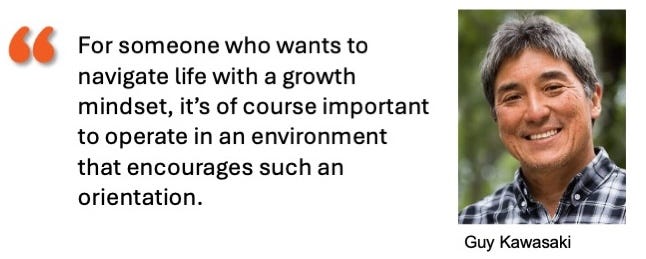
For someone who wants to navigate life with a growth mindset, it’s of course important to operate in an environment that encourages such an orientation. So, if you’re either pursuing or being recruited by a particular organization, what are some good ways to determine if that organization provides an environment that promotes a growth mindset?
Guy offers four suggestions:
Look for investments in learning and development programs. “This shows that the organization believes in investing in people and helping them grow. A simple question is, ‘Does the organization have learning and training classes?’”
Determine if there is diversity in the composition of employees. “Diversity means the organization doesn’t embrace stereotypes, and it sees people for what they can be, not what they are.”
Do your homework by reading the company’s web site, press releases, and reviews on places such as Glass Door. “Look for unwitting tells such as statements like ‘We hire the best and brightest,’ which is vastly different from ‘We help people become the best and brightest.’”
Look for flexibility in the workplace including work hours, in-person attendance, and working conditions. “Flexibility in these areas is indicative of a growth mindset organization.”
What are some telltale warning signs that an organization has institutionalized a fixed mindset?
Guy points to two warning signs that a fixed mindset is institutionalized:
