By Rodger Dean Duncan
“Accountability” is among the top two or three concerns of senior executives.
Accountability has various definitions, but the word is usually used to denote personal responsibility for getting desired results. It’s an admirable idea, and all good managers and leaders want their people to be “accountable.”
Of course, accountability doesn’t apply only to rank-and-file employees. Managers and leaders should be accountable for holding others accountable. After all, isn’t getting good results with and through other people the very reason we have managers and leaders?
I once visited a client organization that employed about 1,300 people. By some standards, an employee population of only 1,300 isn’t a big company. But in this highly specialized, highly technical industry, 1,300 is about average.
I was called in to work with the senior management team on culture and performance issues. At dinner one evening, I asked one of the top executives a pointed question: “Last year, how many of your 1,300 employees received a ‘Needs Improvement’ performance appraisal rating?”
“Six,” my friend answered.
“I’m sorry,” I said. “My question must not have been clear. Of all of your 1,300 employees, how many of them …”
My friend interrupted me in mid-sentence. “Your question was painfully clear,” he said. “Last year, only six of our 1,300 people received a ‘Needs Improvement’ rating.”
He went on to describe his organization as similar to Garrison Keeler’s mythical Lake Wobegone community where all the men are handsome, all the women are beautiful, and all the children are above average.
“We’re good with technology,” he said, “but we’re not at all good at the straight talk that’s necessary for consistently high performance. Sometimes we dance around or even ignore issues that cry out for attention.”
My friend’s assessment of his organization was right on target. And it underscored the common need (1) to define what accountability really means and then (2) to engage people in ways that win their hearts, minds and commitment.
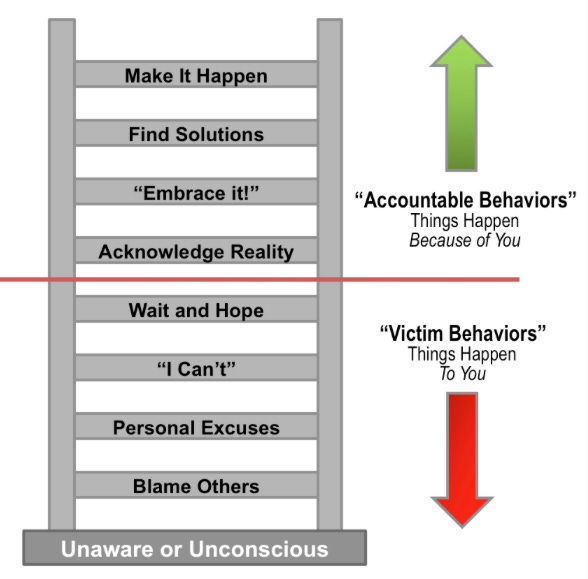
Some of my clients address the matter with something called the Ladder of Accountability.
At the lowest rung on the ladder, people are simply “Unaware” or “Unconscious.” They don’t even know there’s a situation that needs attention.
The next rung on the ladder is the “Blame Others” level. Here’s where we see a lot of finger-pointing. When something goes wrong, or fails to go right, people at this level are quick to censure their colleagues. This is the behavior we frequently saw on “The Apprentice,” Donald Trump’s television show in which young professionals fought it out for a big job opportunity. Rather than fixing problems, most of the contestants invested their energy in fixing blame.