


By Rodger Dean Duncan
Most of us have experienced well-intentioned leaders who miss the mark. At one extreme is the command-and-control leader whose “my way or the highway” approach alienates more than inspires. At the other end of the spectrum is the crowd-pleaser whose need to be liked gets in the way of positive performance.
Neither approach ends well.
Dr. Nate Regier offers smart counsel on how to deal with the conundrum. He’s author of Compassionate Accountability: How Leaders Build Connection and Get Results. CEO and founder of a global leadership firm, Regier hosts a podcast, writes a weekly blog, and contributes to multiple industry publications.
Why, you might ask, do so many people seem to find it difficult to reconcile compassion with accountability?
Regier explains: ”Human beings are social beings,” he says. “We’re programmed to seek connection. Humans are also achievement oriented, motivated to solve problems and get results. But under stress or when the stakes are high, people often default toward one or the other. We’ve discovered that this tendency toward either connection or results has a cultural component and is also strongly influenced by personality.”
Perhaps that’s why many people see compassion and accountability as opposites, somehow working against each other. It doesn’t have to be this way, Regier says. Compassion, in its truest form, includes accountability. You can’t have one without the other.
So, what’s the differences between accountability and responsibility?
Regier says responsibility relates to those things over which we have individual control—our own feelings, thoughts, and behaviors. No more, no less. Accountability, on the other hand, is about the scope of outcomes for which we must account. “For example, if I’m the chief financial officer, I must account for the financial performance of the organization,” Regier says. “But I’m not responsible for the individual spending behaviors of the employees. I am, however, responsible for how I conduct myself in my role.”
Regier says a lot of problems arise when leaders try to assume responsibility for other people’s thoughts, feelings, or behaviors to soothe their own anxiety about outcomes or to compensate for their inability to positively influence others in more effective ways. “Either taking too little, or too much, responsibility can compromise a leader’s ability to be accountable,” he says. “For example, if I’m worried about how my team’s performance will reflect on me as a leader and I don’t take personal responsibility for this by being transparent and asking for help, I might tend to micromanage them. This lowers morale, undermines their capability and autonomy, and hurts the results of my department for which I’m accountable.”
Clearly, compassion versus accountability is a false dichotomy. So, what happens when leaders fall victim to it?
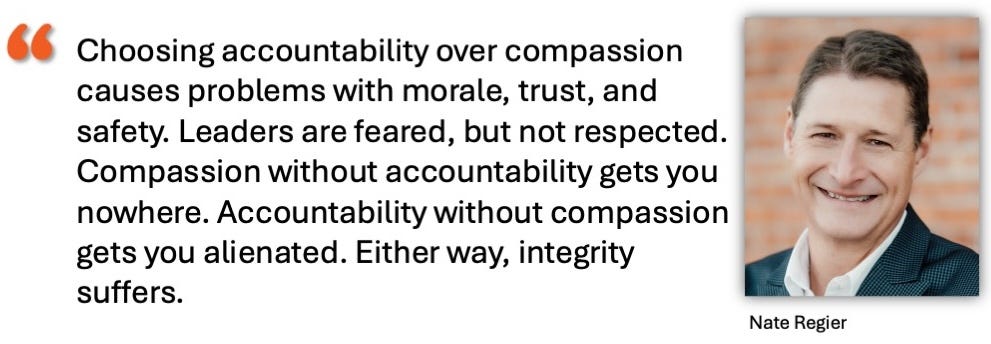
“When leaders fall victim to this false dichotomy, they feel pressure to choose one over the other,” Regier says. “Choosing compassion over accountability causes problems with consistency, follow-through, goal achievement, and quality. Leaders are liked but not respected. Choosing accountability over compassion causes problems with morale, trust, and safety. Leaders are feared, but not respected. Compassion without accountability gets you nowhere. Accountability without compassion gets you alienated. Either way, integrity suffers.”
Regier says trust and integrity are the two most significant benefits to an organization where compassionate accountability is widely practiced. He says compassionate accountability answers two critical trust questions: “Am I safe with you?” and “Can I count on you?”
With compassionate accountability, he says, people experience trust at a deeper level because it combines psychological safety with a commitment to follow-through.
“Integrity is about consistency between values and behaviors,” Regier says. “Compassionate accountability doesn’t compromise values and standards to keep the peace. Neither does it compromise human dignity in the pursuit of results. By separating the person from their behavior, people can be treated with care, concern and empathy while also holding them accountable for behavior.”
As you would imagine, command-and-control leaders can find it challenging to convert to a compassionate accountability mindset.
Regier says many command-and-control leaders have learned two unproductive, but functional habits: vulnerability is weakness, and fear gets short-term results.
“Replacing these habits with compassionate accountability is difficult because these leaders have achieved their goals this way in the past,” he says. “But relationships suffer.”
Regier points out that command-and-control tactics get diminishing returns, and eventually begin to cause turnover and morale problems. “Today’s younger workforce won’t tolerate compromises in either compassion or accountability,” he says. “Command-and-control leaders who want to evolve to become relevant and effective must learn new strategies for influencing people without force and they must open themselves up to being more vulnerable.”
In recent years, there’s been a lot of research on toxic workplace cultures. How can compassionate accountability help transform a culture in a positive, more productive direction?
“Culture is the sum of every interaction between people,” Regier says. “Leaders account for up to 70% of the variance in employee engagement and retention. When leaders use compassionate accountability as a framework for leadership, each interaction is an opportunity to affirm people’s value, capability, and responsibility within the culture.”
Regier says that when people are treated as valuable, they feel safer and confident. This improves trust. When people are treated as capable, they feel more empowered to take initiative. This improves innovation. And when people are treated as responsible, they take more initiative and experience more ownership. This improves follow-through.
He describes what he calls the Compassion Mindset, and explains the keys to adopting it to make compassion a natural, automatic behavior.
“Compassion is the practice of demonstrating that people are valuable, capable, and responsible in every interaction,” he says. “The Compassion Mindset is an attitude, a decision to view ourselves and others as valuable, capable, and responsible. A handy acronym is VCR.”
Imagine three switches that any leader can turn on for themselves and others—VCR. Each switch is necessary, but not sufficient for compassionate accountability.
