


By Rodger Dean Duncan
Will your change initiative succeed or fail?
The 10-minute assessment that reveals your organization’s true change-readiness, even if it seems like everyone’s on board. Take the assessment here.
Are you glossophobic?
That fancy word means fear of public speaking. It’s a common phobia that’s believed to affect three out of every four people. The symptoms range from slight nervousness to full-on panic.
In your professional environment you may have a range of technical skills and subject matter knowledge. But if you struggle with communication—even in situations less formal than a public speech—your value in the workplace is diminished.
Matt Abrahams can help. He teaches organizational behavior at Stanford University, with an emphasis on strategic communication. He’s also a communication consultant for Fortune 100 companies. His latest book is Think Faster, Talk Smarter: How to Speak Successfully When You’re Put on the Spot. (His previous book was Speaking Up Without Freaking Out.)
Abrahams points out that spontaneous speaking is different from traditional “public” speaking.
“If you think about it, most of the communication we do in our lives is not planned as it is with a presentation, a pitch, a meeting with an agenda,” he says. “Much of our communication happens in the moment: answering questions, making small talk, fixing our mistakes, giving impromptu feedback, pitching an idea, etc. This type of spontaneous speaking requires us to be agile, present-oriented, and clear and concise in a way that planned and prepared communication does not.”
Many people struggle with spontaneous speaking because the demands are so intense and the pressures we put on ourselves are so strong. We feel like we need to respond quickly and correctly. This is made worse by the fact that people are rarely taught or given feedback on how to do this well.
For people who have limited experience with spontaneous speaking, Abrahams offers tips for taming the anxiety beast.
“Anxiety looms large in all speaking, planned or spontaneous,” he says. “When addressing communication anxiety, we have to focus both on symptoms and sources. Symptoms are the things that we physiologically and psychologically experience, such as rapid heart rate, shakiness, sweating, and blushing. Sources are the things that initiate and exacerbate anxiety, like worrying about not achieving our communication goals.”
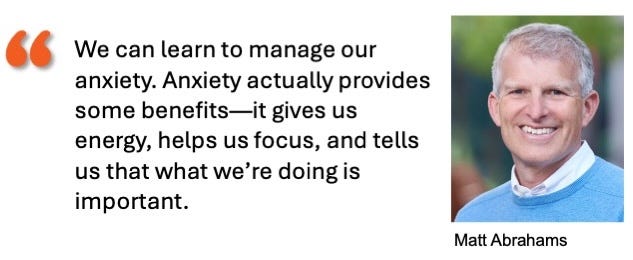
Abrahams says people can implement specific techniques targeted at both symptoms and sources. “We can learn to manage our anxiety,” he says. “Note, I do not believe we ever can, nor would we want to, completely overcome our anxieties around speaking. Anxiety actually provides some benefits—it gives us energy, helps us focus, and tells us that what we’re doing is important.”
He encourages people he’s coaching to create “an anxiety management plan.” This is three to five techniques that people can use to help manage their specific symptoms and sources. “For example, someone might benefit from deep belly breaths that slows down the autonomic nervous system, reduces the heart rate and slows rapid breathing. They might also include a self-affirmation like ‘I have value to bring’ that serves to cancel out negative self-talk that many of us have. Finally, they can work to be present-oriented to cancel out fear of not achieving their future goals by listening to a song, doing something physical, or even saying a tongue twister.”
Abrahams says the six steps of the Think Faster, Talk Smarter method are divided into two categories: Mindset and Messaging.
Mindset involves the following four steps: (1) Managing speaking anxiety; (2) Reducing self-judgment; (3) Reframing spontaneous speaking as an opportunity, not a threat; and (4) Listening intently to what is said and how it is said.
The two messaging steps involve (1) Leveraging structure to package information appropriately and (2) Focusing communication to be concise and clear.
He urges people to “maximize mediocrity” when working on their speaking skills.
