


By Rodger Dean Duncan
Look around you. You’re surrounded by creative people. Or at the very least, you’re surrounded by the work of creative people.
Consider that smart watch on your wrist. What about your TV remote that responds to your voice commands? And the home where you live? It’s the product of architects, designers, and even artists.
The food you eat reached your table because of someone’s creativity (think agricultural scientists, farmers, truck drivers.)
In fact, every single convenience—and necessity—that you may take for granted comes to you by way of someone else’s creativity.
But guess what? You are creative, too. And likely more so than you imagine.
Dr. Seuss had some wise advice on the subject: “Think left and think right and think low and think high. Oh, the thinks you can think up if only you try.”
Someone else who offers some relevant insight is Dr. Steven Kowalski. He’s a leading voice in the global movement for conscious creativity and a seasoned coach and consultant in organizational development. His book is CREATIVE TOGETHER: Sparking Innovation in the New World of Work.
Rodger Dean Duncan: You say that some people have CDD—Creative Disruption Disorder. Tell us what you mean by that.
Steven Kowalski: Actually, most all of us have some form of CDD. It comes from believing an old story about what creativity is, how it works, and who we each are as creators. If we’re walking around with that old story, we most likely believe that creativity is an ability, and some people are just more creative than others. Or we confuse creativity with a special talent, like in the arts. We stop paying attention to the many ways our creativity might show up on any given day. The truth is that creativity is a potential, not an ability. That means it’s there when we need it. Every one of us can access this potential when the circumstances call for it. Walking around with CDD, and believing the old story disables and diminishes access to our creative potential. Embracing the new story frees us to reclaim our creative potential and use it more consciously in our work and lives.
Duncan: In today’s economic climate, many people in traditional jobs are giving entrepreneurship a close look. How can they activate creativity within themselves to improve their chances for success in their fresh career paths?
Kowalski: The key in today’s new world of work is to get creative together.
Maybe you’re working to develop a new product or technology or to improve a manufacturing process. Maybe you’re cutting waste, looking to connect differently with customers, or coming up with ways to mitigate risks. Whatever your goal, in the new world of work, we have to bust the myth that we can create alone. And often, entrepreneurs who start with a strong vision of their “own” can struggle to scale and sustain their vision as it meets with constraints and obstacles out in the world. They can also struggle to inspire and motivate others—especially if there’s no room for others’ creativity to help shape and iterate the entrepreneur’s original vision.
In our hyperconnected, interdependent, and complex world of work, I advocate for shifting to a kind of entrepreneuring that’s founded on co-creation—where we’re generating new value together in ways we couldn’t on our own.
Duncan: What role does clarity of purpose play in people’s ability to unleash their creativity?
Kowalski: Purpose, as it turns out, is the most powerful force that gives rise to conditions that call for creativity. It’s the reason why your creativity might show up at any given moment. The same reason why the status quo doesn’t serve your goals and aspirations any longer. And clarity of purpose is essential to ignite creative potential—especially when that purpose is developed together with others and experienced as “shared.” That means the purpose is crafted together, versus handed down like a mandate.
Purpose generates gravitational pull. It activates creativity. But remember: poorly defined or “weak” purposes generate weak conditions—not “less” creative potential. Strong purposes that are shared and meaningful drive us to overcome the many challenges and obstacles we will likely encounter on a creative venture.
Duncan: The so-called imposter syndrome seems to affect a lot of people’s self-confidence. What’s your advice on dealing with self-doubt?
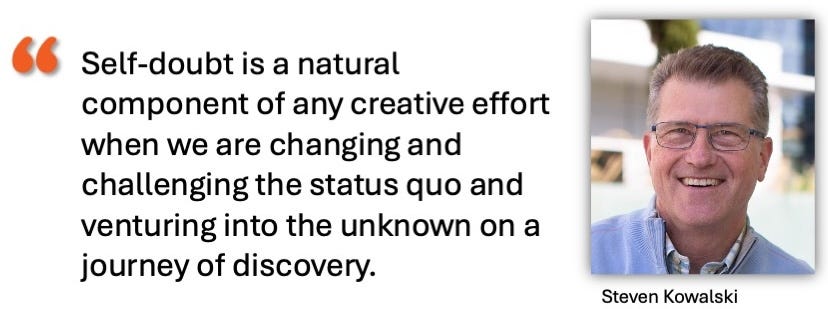
Kowalski: Self-doubt is a natural component of any creative effort when we are changing and challenging the status quo and venturing into the unknown on a journey of discovery. The problem arises when we let self-doubt stop us in our quest. What would happen if we recognized it as a likely test along the way—instead of something to be ashamed of? Then, we could greet our self-doubt with curiosity and even humor rather than with dread. The key is to distinguish when self-doubt is an appropriate response to what’s emerging, like when our next step is unclear, and we are wondering if we need to adjust our approach or change our plan. That’s completely different than when self-doubt is coming from what I call our “inner critic.” That’s the voice of judgment in our head that criticizes and stifles creativity, learning, and exploration. If we recognize our inner critic is stirring up self-doubt, we must adopt a zero-tolerance approach and psyche out the critic.
Duncan: How can members of a team collaborate in ways that take greatest advantage of each other’s creativity?
Kowalski: I like to focus on two critical practices for teams working on projects, initiatives, and ventures that require creativity and innovation: co-creating and sharing leadership.
First, in co-creation, teams jointly produce a tangible product or solution that adds new value—something they could not generate alone. An example from the life sciences industry might be what we call an “integrated healthcare solution.” That’s a constellation of products and services that are integrated to serve a patient’s need more effectively. Co-creation on efforts like these requires individuals on teams to work differently, like iterating and experimenting in shorter cycles and learning when to lean in and advocate for your perspective, and when to let go and support someone else’s perspective.
Second, to share leadership, we have to unbuckle ourselves from the idea that some people have power over others. That means letting go of the power of position and any hint of “command and control.” Instead, we stand together so that anyone can step forward into leadership as the circumstances shift and evolve.
Duncan: What can leaders do to help establish a workplace culture that both encourages and cultivates creativity?
Kowalski: That’s a big question. Mostly because the components of culture operate below the visible surface—things like shared norms, values, and practices that take time to change and evolve.
To evolve culture in ways that foster creativity and innovation, I focus on three arenas—(1) working with leadership and the “shadow” leaders and managers cast on the organization; (2) building skills and capabilities that turn creativity into innovative results; and (3) developing a pipeline of innovation projects/initiatives where people can create tangible, new value.
With respect to the first, the leader’s role, a couple of key watchouts are important. First, be sure that your own “tolerance for ambiguity” is not shutting down exploration and discovery too early in the process. Second, make space for others’ ideas. Your “power of position” can easily lead people to adopt your ideas without questioning, challenging, or disagreeing. And finally, consciously choose when to give answers, and when to ask questions that open up space for others.
Duncan: You say people can claim their “Creative License” by practicing five actions that amplify their potential. What are those actions?
