

By Rodger Dean Duncan
“We are what we repeatedly do. Excellence, then, is not an act, but a habit.”
Is that a quote from a rah-rah motivation speaker?
Nope. It’s from Aristotle, the ancient Greek philosopher. His writings covered subjects ranging from the natural sciences, philosophy and linguistics to economics, politics, and psychology. His own work ethic was legendary, and he clearly understood the connection between good habits and good performance.
In the modern workplace, most people appreciate the role of human habits in an organization’s overall productivity and prosperity. Trouble is, a lot of those same people have habits that don’t serve them particularly well.
Beck Besecker is on a mission to help change that. He’s chief executive and co-founder of Marxent, the global leader in 3D e-commerce for furniture, and a leading voice in promoting work habits that produce happy and high performing employees. He’s author of Your Good Work Habits Toolbox.
The work habits he writes about seem common sense. So why are they not common practice?
“Early in my career my boss asked me to follow up on something,” Besecker recalls. “My response was ‘Got it.’ Not a well-crafted response that communicated when to expect a deliverable, who would be involved, and my approach. Just ‘Got it.’ Of course all those things were in my head, but little good that did for my boss.”
Besecker says getting out of our own heads and considering the needs and perspectives of others is a common theme across many good work habits.
He advocates a practice called 5x5.
“The 5x5 is an email that an employee sends to his or her boss (and leadership) at the end of the week,” Besecker says. “It includes ten bullet points—five bullets for tasks accomplished for this week and five goals for next week. A 5x5 takes about 15 minutes to complete. While a 5x5 may seem like a simple thing, you can glean an incredible amount about someone from it. First, you immediately learn if they have what I call the ‘consistency gene.’ If a new employee fails to submit his 5x5 within a few weeks of being on the job, that’s a major warning sign that they’re slipping in other responsibilities as well. The correlation between bad 5x5 performance and poor job performance is very high.”
Besecker examines the kind of language team members use. Are they accepting responsibility, or do they blame others? Do they take credit or recognize others? He also watches carefully to see if they share or hide bad news. “We work really hard to build a safe place for team members to surface bad news early,” he says, “and 5x5s are a direct line to the top! I can’t tell you the number of times we were able to get ahead of a difficult situation because bad news was surfaced early.”
Finally, he says, “5x5s are a great relationship builder and a real chance for a team member to share their observations, ideas, and ambitions with company leadership.”
Besecker quotes Amazon founder Jeff Bezos as saying, “It’s always better in business to be right than smart.” Why does he embrace that view, and how does he assess if a person has good judgment?
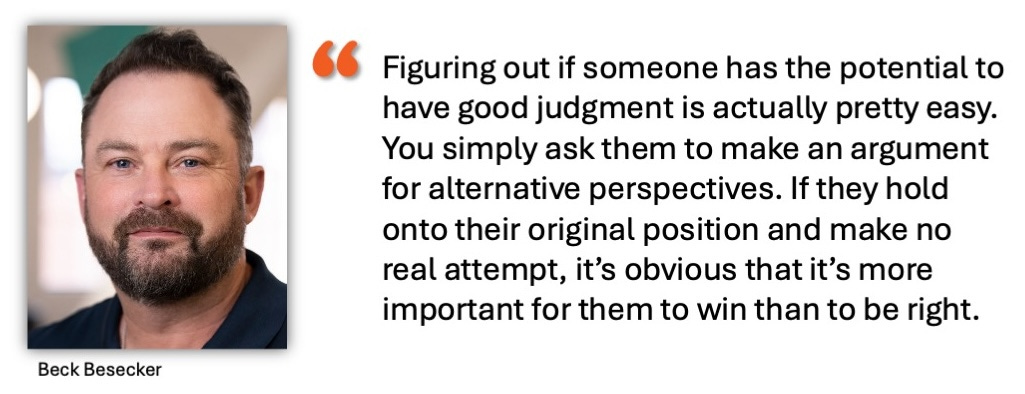
“Figuring out if someone has the potential to have good judgment is actually pretty easy,” he says. “You simply ask them to make an argument for alternative perspectives. If they hold onto their original position and make no real attempt, it’s obvious that it’s more important for them to win than to be right. Helping a team come to the best decision is a lot of work and maybe the toughest part of leadership. My personal style, which took many years to develop, is to avoid ‘coming in hot’ to a meeting with my conclusions already drawn as this approach can shut down productive conversations quickly.”
Besecker suggests questions that people ask themselves to help determine if one of their decisions is sound. He’s boiled his personal “decision pitfall checklist” down to a handful of questions:
Am I making a decision because the alternative is so bad that I’m trying to avoid facing the truth.
Am I trusting someone else’s recommendation because I’m not familiar with the topic? Does that recommendation aligned with what my gut is telling me?
Am I making a decision based on a position I held previously? Is my ego is too big to let it go?
Am I making a decision because it’s popular and will make others happy?
Am I making a decision because a major investment has already been made and it’s going to be really expensive or time-consuming to change course?
“The data you need to make a quality decision is usually right in front of you,” he says. “The trick is figuring out how to take off the blindfold.”
In many ways, the Covid pandemic turned workplace assumptions upside down. What lessons did it teach Besecker about the art of the possible?
“Imagine someone coming to you in December of 2019 and saying, ‘You know, I don’t think we need offices anymore. We can build a big, successful company completely remote!’ You’d have thought they were exercising horrible judgment. We were all suffering from this collective confirmation bias that offices are a critical part of how companies succeed. While the final chapter on remote work has yet to be written, it’s very clear that it can work—but you have to make BIG investments in bringing teams together in other ways.”
