

By Rodger Dean Duncan
“People are born ignorant, not stupid. They are made stupid by education.”
That may sound like a line from a comedian. But it’s actually from Bertrand Russell. You know—the British philosopher, logician, mathematician, historian, essayist, social critic and Nobel laureate. Not known for comedy.
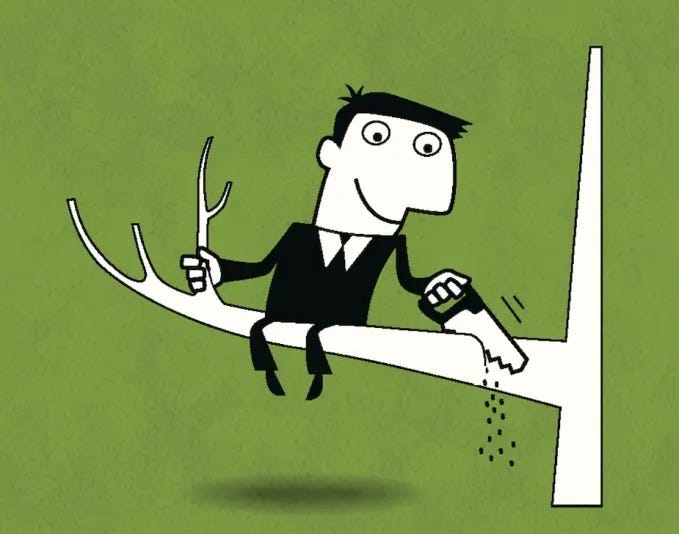
Intentionally or not, Russell provided a fair description of what often occurs in organizational cultures: Rules masquerade as reason. Sketchy thinking becomes strategy. Hair-brained ideas become products destined for the discount warehouse. Unchallenged nonsense evolves into the status quo. People go along to get along.
Such unproductive environments are rarely the work of a single person. This kind of imprudence is nearly always a group activity, a collusion of silent partners.
The result is what management innovator John Brandt calls Nincompoopery.
Yes, it’s a made-up word. But of course all words are made up. And this one aptly describes behaviors that can frustrate managers, demoralize employees, and run customers to the competition.
Brandt offers some excellent antidotes in Nincompoopery: Why Your Customers Hate You—And How to Fix It.
Rodger Dean Duncan: You say individual nincompoops are not the big problem, it’s the nincompoopery—i.e., the meta-foolishness—of the companies and systems in which people are forced to work. Give us a couple of high-profile examples of nincompoopery in the workplace.
John R. Brandt: When the Segway was introduced, the company predicted sales of 10,000 per week—at $5,000 each. Unfortunately, as cool as a stand-up, self-balancing, motorized scooter may be, most people couldn’t imagine why they needed one. Segway ended up lowering its prices and focusing mainly on police, industrial, and tourism markets—and sold 24,000 over the first five years (or roughly 2,576,000 fewer units—and about $13 billion less in revenue—than expected), at lower margins.
This is innovation nincompoopery on a grand scale. Too many leaders believe that innovation is only or mostly about technological wizardry. It’s not. In fact, if your technological innovation is too early—before customers see a clear need and payoff in adopting a new technology, which experience has taught them is likely to be painful, prolonged, and often unrewarding—you’re in big trouble. There’s no lonelier feeling than trying to convince customers to buy something they’ve never heard of and don’t understand, while commanding a premium price. Evangelism has its rewards, but they’re usually redeemed far in the future, or after you’re dead. Neither time frame is helpful in delivering profits today.
Another great example of how important (and lucrative) it can be for companies to manage and minimize their own nincompoopery is what McKinsey & Company calls the “moment of truth.” This is when there’s an opportunity for something to go dramatically right with a customer, or, perhaps more often, immediately after something goes drastically wrong. How we respond—with empathy or apathy— will shape our relationship with that customer forever.
A study in Europe found that 87% of bank customers who had positive experiences during moments of truth (a check put on hold, a bank error, receiving financial advice) increased their share of wallet with the bank. Just as telling: 72% of customers who had negative experiences downsized their relationships with the bank. Banks—and other companies—win or lose based on how well they minimize nincompoopery.
Duncan: Why—and how—do smart, well-intentioned people fall into a pattern of nincompoopery? What are the early warning signs?
Brandt: Part of it is human nature. We get comfortable, we fall into routines, and we find ways to slip past our own unease at the fact that things don’t work as well as they should. Or, even worse, we start ignoring or ridiculing the frustration of our customers.
How many times have you heard someone say, in jest or not, that their job or business would be terrific—if it weren’t for their cranky, stupid customers? Newsflash: Those customers aren’t stupid, but they are cranky because not only are you screwing up, you’re not listening to them even as they try to help you. A customer complaint is a gift, because the customer is saying that he or she cares enough about you, and what you do, that he or she wants you to do it better. You’ve been given a chance to deepen your relationship with that customer.
So the clearest warning sign of impending nincompoopery is when senior leaders create a culture in which legitimate concerns or complaints, whether from customers or employees, aren’t heard or tolerated. This can be due to active suppression, as leaders stifle dissent or disagreement because they see them as challenges to authority. Or it can be slower and more insidious, as leaders avoid the place where real work is done (the production line, a service call) and where real customers live and work (in homes or businesses).
Net promoter scores and customer satisfaction surveys are no substitute for listening to real people who buy things from you, and the employees who help them.
Duncan: What do you see as some of the trends that make it challenging for leaders to avoid nincompoopery?
Brandt: Think about the amount and speed of change we’re wrestling with: The original telephone needed 50 years to move from 5% to 50% reach into US households. Smartphones went from 5% to 40% in four years—during the worst economic downturn in 70 years.
Globally, the number of Internet users reached 3.9 billion in 2018, roughly half the world’s population. Yet even as we connect to others, we’re individually dazed and confused. With more than seven billion smartphones in use today, we’ve created an environment in which we and our employees can, if we want to, work 24/7, checking our phones up to 150 times a day. We think we’re all more productive, thanks to connectivity and multitasking, but research says we’re not. In fact, we lose up to 40% of our productivity by switching between tasks. The more we switch, the worse our performance.
And that’s just scratching the surface of what we’re trying to manage. Employees and managers are overwhelmed, which can lead to decision fatigue and paralysis—and nincompoopery.
Duncan: What sort of “audit” can be done to identify and begin the eradication of corporate nincompoopery?
Brandt: It comes back to listening. If your organization doesn’t have a program in which every employee—from CEO or owner to frontline worker—spends at least some time with a customer at least once per year, you can’t expect to outperform competitors, or maybe survive. And this time can’t be spent selling or attending the big game. You have to figure out how to work directly alongside the customer, in his or her workplace or home, observing how he or she operates in his or her own environment. This is the only way to identify nagging problems and new challenges that you can solve, as well as finding out how badly you’re currently goofing up on your responsibilities.
Small companies, which are often closer to their customers than large companies, should have a huge advantage here, though they often squander it.
Duncan: What can an individual worker do to avoid falling victim to corporate nincompoopery?
