


By Rodger Dean Duncan
If you appreciate the study of leadership, you’ll certainly recognize names like Covey, Maxwell, Peters, Bennis, Blanchard, and Kouzes. These modern-day experts help us understand and practice the art and science of influencing people.
But we can reach back—way back—in history to consider a much earlier focus on what makes for effective leadership.
Plutarch, the Greek-turned-Roman historian, profiled dozens of ancient personalities in his now-famous work called Parallel Lives. For centuries, that study has been a staple in universities. But you can bet it’s not on any of Amazon’s bestseller lists.
Today, the appetite seems to be for quick-read hero-worship of hot shot turnaround artists or celebrity C-suite execs who understand social media as well as they do balance sheets.
Enter Stanley McChrystal. After graduating from West Point, he served 34 years in the U.S. Army. His last assignment before retirement was as a four-star general in command of all American and coalition forces in Afghanistan.
You might assume that with a career like that behind him, McChrystal would have his fill of studying leadership. Not so. With two collaborators (Jeff Eggers and Jason Mangone) and a team of researchers, McChrystal jumped headlong into an investigation of leadership far beyond anything he’d experienced or observed in the preceding decades.
The result is Leaders: Myth and Reality.
With Plutarch’s Parallel Lives as a model, McChrystal examined parallel sets of leaders who followed unconventional paths to succeed.
For example—
Hollywood icon Walt Disney and French fashion designer Coco Chanel. Both built empires, but in very different ways. And both had public personas that sharply contrasted with how they led in private.
Boss Tweed, the famously corrupt New York politician from the 1860s, and Margaret Thatcher, the longest-serving British prime minister of the 20th century. Both followed unlikely roads to the helm of powerful institutions.
Martin Luther, a seminal figure in the Protestant Reformation, and his namesake Martin Luther King, Jr., known for his work in behalf of American civil rights. Both started as local clergymen, then emerged from modest backgrounds to lead world-changing movements.
As the book title suggests, McChrystal has identified three common myths about leadership—myths that can produce less effective results:
The Formulaic Myth—Simply follow a checklist of behaviors and you’ll be a great leader.
The Attribution Myth—The success and failures of a team flow mostly from the influence of its leader.
The Results Myth—Delivering results is all that’s required for positions of power and accolades.
To explore these findings further, I sat down for a conversation with Stan McChrystal.
Rodger Dean Duncan: You’ve identified three leadership myths that you say are widely recognized and even followed but that lead people astray with adverse consequences. If the myths don’t produce good results, why do people embrace them?
Stanley McChrystal: We found that these three leadership myths sort of jump out of our research. They are embraced by people because, first, they simplify understanding leadership. In fact, they over-simplify leadership. For example, with the Formulaic Myth you can come up with a list of leadership traits that are easy to describe. The list may not necessarily be accurate, but it’s easy.
The same with the Attribution Myth. We often give leaders credit for the success or failure of an organization far in excess of what they actually deserve. Again, it makes evaluation of leadership much simpler. When you think about how history is written, we often write leader-centric history. So it’s clean to say this army had a better general so they won. In reality, it’s usually much more nuanced than that.
With the Results Myth, we follow leaders who don’t actually produce good results. That was more interesting to me yet less intuitively obvious. But leaders fulfill a need in us as followers. And it’s not always about results. It involves the need for something to believe in. As a consequence, some pretty bad leaders turn out to be pretty darn powerful.
Today I’m asking questions I never asked before.
Duncan: Of the three leadership myths you’ve identified, which one do you regard as most common and what role does it play in the perpetuation of less-than-excellent leadership?
McChrystal: I believe the Formulaic Myth is the most common. That’s because we like to write down lists of top leadership traits and that sort of thing. It makes it seem that if we simply follow these rules we’re going to be effective. But this approach tends to ignore the contextual nature of leadership.
Duncan: People like check lists, and although simplicity has its place, too much of it can get you in trouble.
McChrystal: Exactly.
Duncan: You’ve said that mastering the art of “followership” is one of the keys to becoming an effective leader. What does that “look like” in terms of observable behaviors?
McChrystal: If we think about the times we’ve been in leadership positions and we had followers that we very much valued or appreciated, often they were ones who took the time to understand what we as leaders were trying to do and they gave us credit for intent if not perfect guidance. They filled in the blanks. If someone does only exactly what you tell them to do, the result is often not quite right.
Effective followership is a combination of trying to put yourself in the mind of the leader, trying to understand what that leader wants to have occur—the desired outcome—and then filling in the holes so you get there.
There’s also value in things like overt loyalty. Sometimes leaders need subordinates who stand up in front of other followers and say “Okay, this is what we’re going to do.”
Understanding the power of good followership helps prepare a person for leadership.
Duncan: You’ve acknowledged that a multi-generational, diverse workforce requires leaders who can build consensus and a shared sense of purpose. What kind of behaviors enable a leader to do that?
McChrystal: I think one of the first is establishing a connection with followers. Followers must believe that they’re an important part of the success equation, not just automatons responding to the leader’s guidance. And they must know that the leader believes that, too.
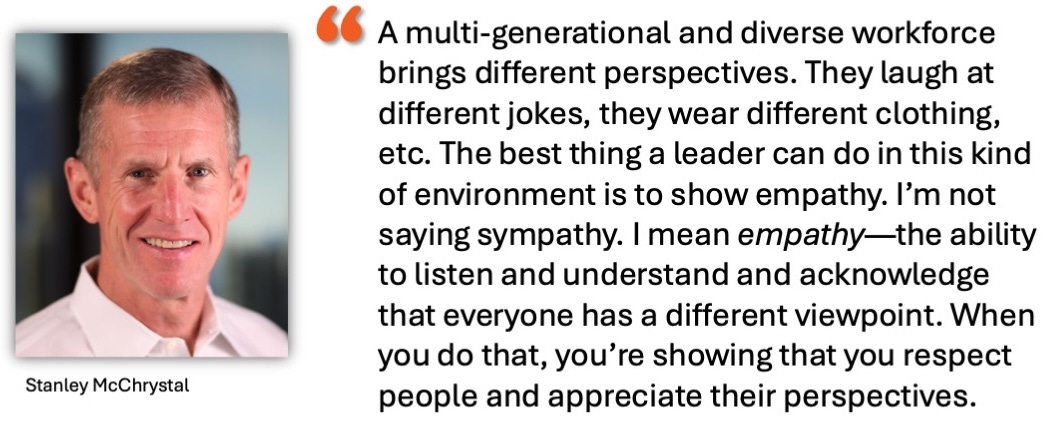
A multi-generational and diverse workforce brings different perspectives. They laugh at different jokes, they wear different clothing, etc. The best thing a leader can do in this kind of environment is to show empathy. I’m not saying sympathy. I mean empathy—the ability to listen and understand and acknowledge that everyone has a different viewpoint. When you do that, you’re showing that you respect people and appreciate their perspectives.
Duncan: Years ago at Campbell Soup Company I worked with a very effective CEO who used to say that the quality of your ideas is not directly proportional to your title or where your parking place is located.
McChrystal: That’s absolutely right!
Duncan: One of the people you highlight in your book is Leonard Bernstein, conductor of the New York Philharmonic. What cues can other leaders glean from an orchestra conductor?
McChrystal: For a long time, orchestras didn’t have conductors. Conductors arose in the nineteenth century and the baton because the symbol of power. In reality, what a good conductor does is help every member of the orchestra understand the music in a similar way. A good conductor paints a picture of what the music should sound like when all the musicians play together. A good conductor provides vision and enthusiasm. And then—in the moment—the conductor must provide a coordinating function so all the musicians focus on their own technical excellence and are enabled to perform as an orchestra as opposed to individuals.
I like to remind people that conductors don’t create any music. If the orchestra were not present, all the arm swinging in the world by the conductor would produce nothing but sweat. The magic is in the connection between the conductor and the musicians.
Duncan: Power, you say, is derived more from reputation than rank, more from persuasion than direction, and more from example than prescription. Why do so many people in leadership positions seem to have missed that lesson? What price are they paying?
McChrystal: A lot of people equate positional power with real power. Of course there’s some power in position—for example, enabling a person to approve or reject certain things. They might be able to promote or fire people. But the reality is that the power to truly influence people’s behavior is strongest when it’s all about example.
In the Army I once had a battalion commander who wore his T-shirts backwards because he said he’d learned in Vietnam that soldiers were less vulnerable if their T-shirts covered more of their neck, which would be visible to the enemy. I noticed that a tremendous number of people in the battalion were wearing their T-shirt backwards simply because this very credible individual had said this was a good idea.
In my view, real, long-term power comes from the ability to persuade people that they should do or not do something based on your suggestion or example. That’s much more effective than transactional things based on only title or position.
Duncan: Of course in many organizations we find people with tremendous influence because of who they are rather than rank or tenure.
McChrystal: Yes, that’s so true. As you suggest, the most influential people in an organization are often not the people with the best parking places.
Duncan: You point out that leadership success is highly contextual. How would you advise leaders to use situational awareness to enhance their likelihood of producing positive results?
