

By Rodger Dean Duncan
In the words of psychiatrist R. D. Laing, we live in a moment of history where change is so fast-paced that we “begin to see the present only when it is already disappearing.”
Change is not just faster. It’s also exploding in quantity and magnitude. Experts say we can expect more change in our lifetimes than has occurred since the beginning of civilization more than ten millennia ago.
Trying to keep up with change can feel like getting trapped on a runaway treadmill. Managing it can be even harder.
This reality poses special challenges for people in the workplace.
Think about it. Many of the top jobs on LinkedIn didn’t even exist just a few years ago. It’s anyone’s guess how many as-yet-unknown jobs will be the hot tickets ten years from now. Or even five. Or maybe even two.
Nobody understands this better than Michelle R. Weise, a renowned thought leader in the field of the future of work and education. She’s founder of the Strada Institute of the Future of Work. Her thought-provoking book is Long Life Learning: Preparing for Jobs That Don’t Even Exist Yet.
For anyone who wants to take a proactive approach to education and career planning, Michelle’s insights are worth of consideration.
Rodger Dean Duncan: Due to the “algorithmic editing” of their online searches, many people live inside a so-called “filter bubble” and no longer have access to a balanced information diet. What’s your advice on dealing with such filters?
Michelle R. Weise: How we relate to one another is changing drastically because of new forms of artificial intelligence. We’re surrounded by things with which we agree as opposed to differing viewpoints that might challenge our thinking and make us feel uncomfortable. This is hugely problematic as we consider that researchers are suggesting that empathy and emotional intelligence are skills that may empower us to out-compete or better coordinate with machines in the future.
At first blush, it seems promising that more automation will force us to demonstrate our uniquely human skills. But just because we’re human doesn’t necessarily mean we excel at the human side of work. These aren’t innate skills; we must practice them.
Duncan: So what’s the implication of this?
Weise: It’s hard work putting ourselves in someone else’s shoes. But it’s much harder to empathize when we’re never exposed to those challenging views in the first place. It’s therefore important that more of our citizenry become aware that this is happening through every single click we make in the apps we use on our smartphones, tablets, or computers.
Countries like Finland may have the right approach with its “1%” AI initiative. With the support of government and private companies, the country is trying to teach 1% of the country’s population (approximately 55,000 people) basic concepts at the root of artificial intelligence technology. Although seemingly small-scale, the thrust of what the country is trying to accomplish is incredibly important.
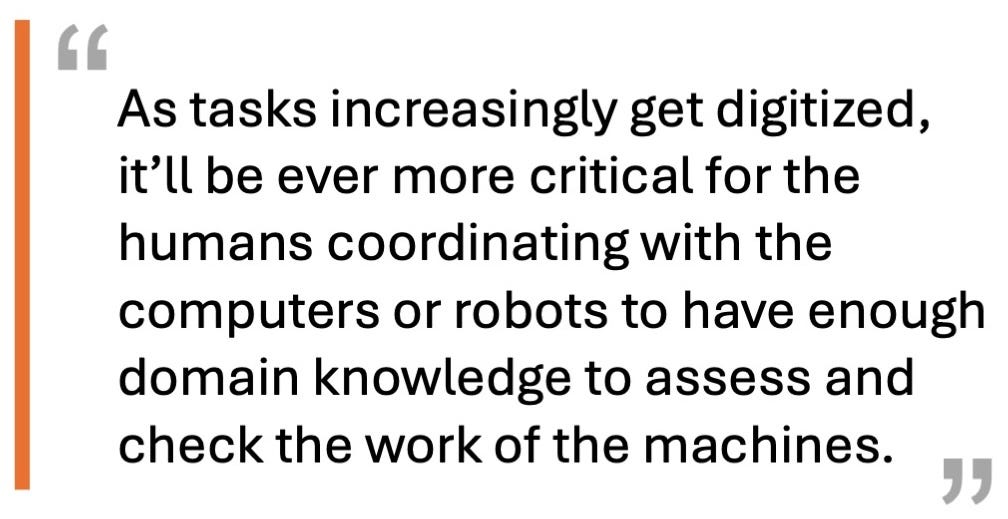
As tasks increasingly get digitized, it’ll be ever more critical for the humans coordinating with the computers or robots to have enough domain knowledge to assess and check the work of the machines. We must be able to question the AI that undergirds all of our technologies, rather than let these technologies outstrip our ability to control them. Otherwise, our filter bubbles will become even more insular, and our ability to connect with one another will weaken without practice.
Duncan: The effect of more hours focused on screens means that people are investing less time practicing person-to-person skills with others. What’s the impact of that on an individual’s preparation for the workplace of the future?
Weise: Without deliberate practice of our human skills, we may inadvertently be impairing our competitive advantage for the future of work. Emotional intelligence, or our emotional quotient (EQ), as an example, is connected to larger issues of self-awareness and self-control, as well as optimism and flexibility. It helps us persist, face hardship, and deal with delayed gratification. In our work lives, it means we can take feedback well and demonstrate grit in the face of real challenges. Our bosses view us as more accountable and coachable with stronger EQ. These leadership skills are a powerful differentiator for employees; higher EQ translates into earnings on average of $29,000 more per year. But without deliberate practice, we may end up derailing or stagnating, unable to advance in our careers and provide for our families.
Duncan: In addition to paralyzing the world economy, the Covid-19 pandemic has unmasked a lot of problems that were in plain sight. What has the pandemic helped reveal about the issues of learning?
Weise: The global pandemic laid bare how fragile our multiple, fragmented systems of K–12 education, postsecondary education, and workforce training are. Siloed and unintegrated, our systems had long neglected millions of people looking to access the relevant information, funding, advising, support, and skills training they need in order to advance. And when Covid hit, it became all too clear that our systems of learning and work were not equipped to skill up and transition large numbers of workers to jobs that are in demand.
Duncan: For a variety of reasons, online courses are gaining “market share” in the world of education. What are the keys to creating and delivering an online course that is not only engaging for the students but actually delivers great value?
