


By Rodger Dean Duncan
Will your change initiative succeed or fail?
The 10-minute assessment that reveals your organization’s true change-readiness, even if it seems like everyone’s on board. Take the assessment here.
Very early in my career I worked for a prominent company on Wall Street. A few months after coming on board, I was asked to engage in a practice that, although not illegal, I regarded as clearly unethical.
I pushed back by pointing out that I was successful in my work without using the questionable practice. While acknowledging that was true, my boss told me that in order to advance in the company I would need to teach the practice to others. I couldn’t get him to see the disconnect: Why would I be willing to teach others a practice that I regarded as wrong?
We were at a stalemate. So, I quit.
It was a scary time. I had a wife, a 2-year-old, a newborn baby and no job. The good news is that this decision was a springboard to professional opportunities I’d never dreamed possible.
Not every situation like this has such a happy ending.
Executive coach Ira Chaleff offers some excellent counsel in his book Intelligent Disobedience: Doing Right When You’re Told to Do Wrong.
Chaleff uses the metaphor of the guide dog. If a blind man inadvertently walks too close to the edge of a train platform, his guide dog will pull him decisively away from it. This is known as a “counter-pull.” It might be a good term to use when a leader is about to step off the edge into unknown danger.
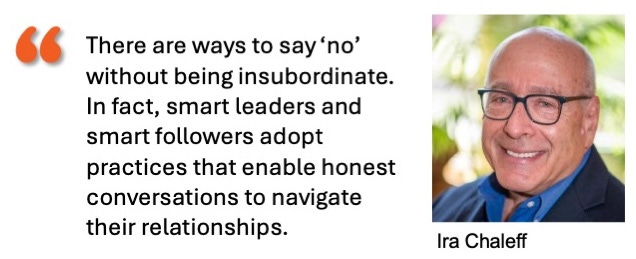
There are ways to say “no” without being insubordinate. In fact, smart leaders and smart followers adopt practices that enable honest conversations to navigate their relationships.
To explore some of those practices, I interviewed Ira Chaleff.
Rodger Dean Duncan: What’s the best way to say no to a directive you regard as wrong (dangerous, duplicitous, unlawful, immoral, etc.) without coming across as insubordinate?
Ira Chaleff: First, let me emphasize that not all orders to which we should say “no” are ethical matters. Often a senior executive will issue an order before having the full picture, not realizing that the order is incorrect for the current situation. It’s the responsibility of those receiving the order to fill in the correct picture and save the executive from making an expensive or embarrassing mistake.
Regardless if the matter is ethical, operational, or a matter of public image, it can be difficult to get the executive to give it the attention it deserves. They are focused on priorities that have a large impact on the future of the company and resist distractions. This is why those around executives need to develop the art of getting their attention before trying to correct their information.
You do this by linking the matter to what is already important to them. If shareholder value is their top concern you might say “There’s something I need to inform you about that could impact shareholder value.” Once you have their attention you can say why you should not do what was just ordered and present an alternative suggestion.
Duncan: How can a leader encourage intelligent disobedience without undermining the need for compliance and order in the workplace?
