


By Rodger Dean Duncan
Let’s face it. The Covid pandemic brought more disruption to our lives than most of us could ever have imagined.
Businesses of every kind were forced to alter their operating models.
Schools at every level were scrambling to serve their students, coping with the tenuous (and ever-changing) balance between safety and effective learning.
Football teams played in empty or near-empty stadiums while baseball and basketball teams played in front of cardboard cutouts of fans while phony crowd noise was piped in to help it all seem “normal.” Surreal.
At my bank I told the manager “There was a time when you’d be concerned if someone walked into the bank wearing a mask. Now you won’t let anyone in who isn’t wearing a mask.” I think he might have smiled, but I can’t be sure.
Alas, even years after the pandemic there’s at least one thing that doesn’t seem to have changed. A lot of people are still less than happy with the leadership they receive in the workplace.
An MIT study shows that only 12% of employees strongly agree that their leaders have the right mindsets to lead them into the future. Meanwhile, an Edelman Trust index found that only 50% of people in the U.S. trust business as an institution.
We can do better. We must do better.
What kind of leaders do people want? They want leaders who can navigate the speed and complexity of the digital workplace. They want leaders who explain the why of the work, who connect with empathy, who communicate with authenticity, and who collaborate with openness.
Becoming this kind of leader requires deliberate choices and habits.
That’s the message of a book by Alain Hunkins titled Cracking the Leadership Code: Three Secrets to Building Strong Leaders.
Drawing from decades of fieldwork and research, Hunkins provides a comprehensive—and realistic—approach to becoming the kind of leader who can inspire people to top performance. His consulting clients range from Pfizer, General Electric and IBM to General Motors, Microsoft and WalMart.
Rodger Dean Duncan: You quote a Ketchum survey of more than 25,000 people from 22 industries on five continents that show only 23% of respondents believe their leaders are leading well. Many other studies show similar results. To what do you attribute such anemic confidence in leadership?
Alain Hunkins: Leadership has been mired in mediocrity for quite some time now. Most mediocre leaders are in denial. They genuinely believe they’re doing a good job. None of them wake up on a typical workday thinking, “Today, I’m going to be lousy communicator and most of my team won’t trust me.” While they mean well, their good intentions don’t translate into good results.
Surveys like Ketchum’s ask people for candid feedback about their leaders’ behavior. Since the surveys are confidential, there’s no downside to sharing the truth. The results provide a clear snapshot of leadership effectiveness.
Sadly, most leaders don’t ask their own people for this same level of candor. Moreover, employees aren’t about to give unsolicited feedback. Power dynamics are alive and well, and employees know giving honest feedback could be a career-limiting move. As a result, leadership has blind spots.
Some companies institutionalize these blind spots. I experienced this firsthand working with a Fortune 100 manufacturing company. On my way to meet with the CEO and the Executive Team, a Senior Vice President took me aside, and told me, “These guys run this company, and they know they run this company. When you go in there, one word you never use is “no.” You can say “maybe”, or “possibly,” or “I’ll look into it,” but you never say ”no.” Do you understand?” He then waited for my verbal “yes”—only after which I was permitted to go into the boardroom.
Without external feedback, leaders can’t bridge the gap between their own intentions and others’ perceptions. They’ll remain blind to their own blindness. They’ll stay mired in mediocrity.
Duncan: You focus on four principles of strong leadership—context, connection, communication, and collaboration. How did you arrive at those four principles?
Hunkins: The content grew organically from the process of training and coaching tens of thousands of leaders over two decades. They shared personal stories of their own failures and successes. I started taking notes and writing blogs about what I was learning. As I reviewed my writing, I saw patterns of behavior emerge.
It turned out that the best leaders had certain things in common, and so did the lousy ones. As I started to categorize these behavioral patterns, I saw that they fell into three main categories:
Connection: Leadership is built on a foundation of human to human relationship. Lousy leaders put tasks first. Strong leaders put people first.
Communication: People don’t want information as much as they want insight. Lousy leaders share data. Strong leaders share understanding.
Collaboration: Great teams and great cultures don’t happen on their own. Lousy leaders create an environment by default. Strong leaders create an environment by design.
Besides recognizing behavioral patterns, I also spotted patterns of thinking. Strong leaders shared similar beliefs and assumptions about leadership, as so did the lousy leaders. How did these mindsets differ? What gave rise to these mindsets in the first place?
The opening section on context seeks to answer these questions. It explores the history of leadership and the legacy that most leaders have unconsciously inherited. Organizational leadership was birthed in the industrial age, for a world in which 95% of the workforce performed repetitive manual labor. This was the world in which Henry Ford famously said, “Why is it every time I want a pair of hands, they come with a brain attached?”
In Ford’s day, command and control was a viable strategy. Today, it’s not.
In our knowledge economy, today’s leader needs to work from an upgraded playbook.
Duncan: What role does empathy play in a leader’s ability to inspire people to perform well?
Hunkins: Empathy is a leadership superpower. Leadership, at its core, is a relationship between leader and follower. The quality of that relationship is based on the quality of the connection between them. How do you improve the quality? Show people you understand them and care how they feel. In other words, connect with empathy.
How people feel profoundly impacts how they perform. Gallup has found that highly engaged teams show 21% greater profitability. What’s the fast track to engagement? Empathy. When people feel their direct leader cares for them, they are 1.3 times as likely to stay with the organization and are 67% more engaged.
Duncan: Is it possible to “practice” empathy so you can get better at it? How?
Hunkins: The good news is that while empathy may seem intangible, it’s actually a group of specific learnable behaviors. This means that empathic skills can be practiced and mastered. Think of empathy as a muscle—if you exercise it, it gets stronger.
The keystone skill to develop empathy is listening with purpose. This type of listening is quite different from what most people are used to. For starters, it’s not about waiting for the other person to stop talking so you can give advice.
Listening with purpose means giving your complete and undivided attention. It’s actively seeking to see reality the way the other person sees it, and to feel it the way they feel it. It means suspending your own agenda, and “holding space” for their agenda. This kind of holding space takes energy and can be exhausting. However, the investment is worth the return. Empathy builds trust, yields insights, and fosters innovation.
Duncan: You quote Dwight Eisenhower as saying motivation “is the art of getting people to do what you want them to do because they want to do it.” What leadership behaviors help produce that kind of response?
Hunkins: Eisenhower’s quote highlights the innate challenge of motivation. His “because they want to do it” is the really tricky part. If motivation were as simple as getting people to do something, we’d just wield authority and get compliance. To get people to want to do something, we have to use influence to create commitment. Want to isn’t a request to someone’s head. It’s an appeal to their heart.
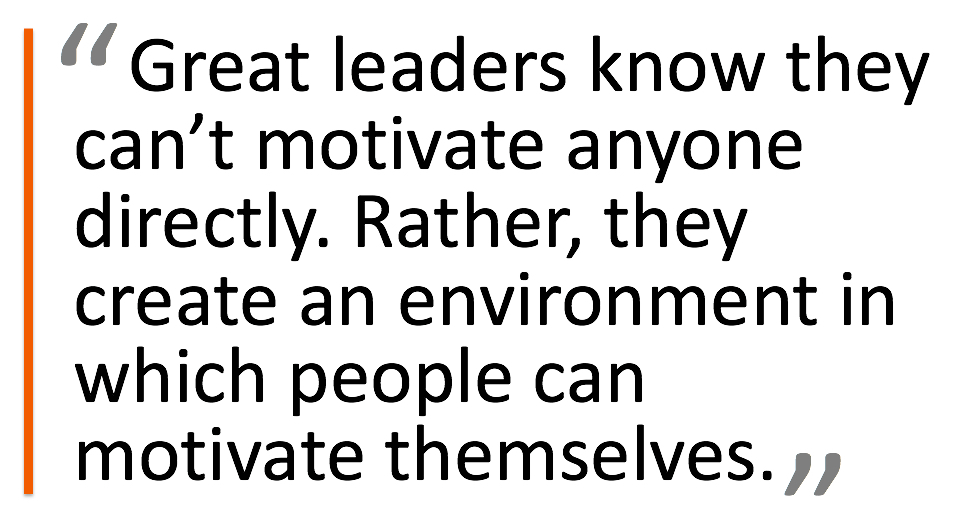
Great leaders know they can’t motivate anyone directly. Rather, they create an environment in which people can motivate themselves. Leaders do this by satisfying the four human needs that, when met, allow people to perform at their best. These are the needs for safety, energy, purpose and ownership.
There are countless behaviors leaders can use to meet these various needs. For example, one way to meet the need for safety is to ensure everyone’s voice is heard in relatively equal part during team meetings. A way to meet people’s need for energy is to make meetings 50 minutes long instead of one hour. That gives people a physical and mental break before starting their next meeting.
Duncan: What can leaders do to help people embrace—and be inspired by—the “why” of their work?
