


By Rodger Dean Duncan
As if we don’t have enough challenges affecting the workplace (scary economic conditions, assaults on freedom of speech, and the lingering effects of a global pandemic), one age-old problem lingers like an uninvited party guest: bullying.
For organizations, bullying can result in attrition of skilled employees. It leads to higher absenteeism, diminished productivity, damaged reputations, and a whole slew of performance problems. For individuals, bullying is associated with a number of stress-related health problems such as insomnia, anxiety, depression, and even cardiovascular illness.
But just as it’s possible to mitigate physical safety risks (handrails on stairs, fire extinguishers, skid resistant flooring), it’s possible to deal proactively with bullying.
That’s the view of Dr. Rob Fazio, a leadership psychologist who works with C-suite executives, medical professionals and athletes. His book is BullyProof: Using Subtle Strengths to Influence Alphas and Strengthen Society.
Rodger Dean Duncan: How do you define workplace bullying, and how prevalent is it?
Rob Fazio: Bullying is a combination of consistent behaviors by someone who has a negative impact.
An alpha is someone who takes the lead in a situation regardless of whether they are the identified leader or subject-matter expert. Being an alpha is neither good nor bad. A bully is someone who consistently attempts to get what they want regardless of the costs. I encourage people to focus less on the term “bully” and identify the behaviors that create the negative experience. The reason for this is that once we fall into calling someone a bully, we put ourselves in a position where we give them more power and take power away from ourselves.
Workplace bullying happens more than people realize. Every day, millions of people suffer from workplace bullying. According to the Workplace Bullying Institute’s U.S. Workplace Bullying Survey of Adult Americans, 30% of survey participants experienced bullying at work, 19% witnessed it, and 4% admitted to perpetrating it. That means 49% of US workers are affected by workplace bullying. If you apply those statistics to the country as a whole, that equates to 79.3 million people.
Duncan: How common is it for someone to be a bully and not even realize it? Why?
Fazio: It’s very common. We encourage people to look at themselves first. There are 27 “bullying behaviors” that we’ve identified that lead the experience of people feeling bullied or dominated. Many people engage in these behaviors without realizing it. The impact is often the same: people on the receiving end can feel powerless or defeated. An example of a common bullying behavior that’s usually not intentional but was impact is giving unsolicited advice and trying to change someone’s mind. The reason people don’t realize they are bullying is that they are just going with what they know, they believe they are being helpful and using their own strengths.
Duncan: What are the costs of workplace bullying—to the people who experience it and to their organizations?
Fazio: The physical, financial, and psychological costs of bullying are tremendous. There are well known negative impacts, such as increase in turnover, disengagement, anxiety, and illnesses as well as a decrease in productivity. People will stop focusing on work and focus more on the impact of being bullied. And worse, bullying infiltrates people’s home lives and mental health.
Duncan: What exactly do you mean by the term BullyProof?
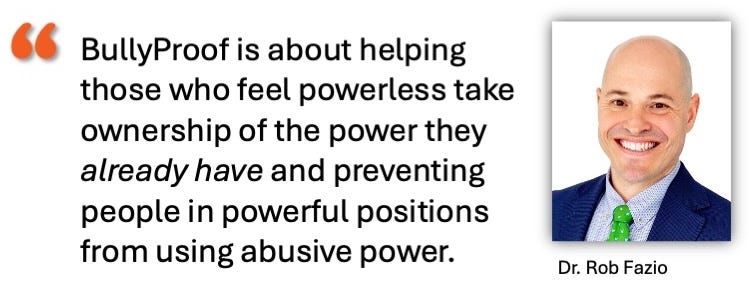
Fazio: BullyProof is about helping those who feel powerless take ownership of the power they already have and preventing people in powerful positions from using abusive power. It’s a commitment and a journey that includes developing a mindset of strengthening yourself and others. There are 11 BullyProof strategies that range from understanding how we get triggered, to empowering and equipping ourselves, to understanding how to apply the neuroscience of influence.
Duncan: You coach people who experience bullying to exchange the “victim view” for the “ownership view.” Please explain how that works.
Fazio: I have always thought that people get pulled into a reactive state of mind and unintentionally give people permission to bully them. We have a culture in the US of not blaming “victims.” I want to encourage people to take ownership, build intentional alliances, and not feel like victims.
With every event, we have a decision to make: Will we reject what has happened and resist it, or will we accept what has happened and do what we can to improve the situation? This decision, reject or accept, sets the cycle of victim or ownership in motion. If you choose to reject the event and resist what is happening, the victim cycle begins, where we focus on what others aren’t doing rather than what we can be doing to adapt or get ahead. We redirect and blame, talking about what is wrong rather than what can go right. We rationalize, explaining to ourselves and others why our victim mentality is the best response to the situation. We may even end up creating a victim alliance, where others join our pity party and enter into the victim cycle with us. Finally, we retract, where we disengage and “leave without leaving.” Eventually we may leave physically too, like the team members in our example.
However, if you accept the event instead of rejecting it, you enter the ownership cycle. Accepting an event doesn’t mean agreeing with it; it just means you’re ready to deal with it and move towards action rather than reaction. When you accept what has happened, your attitude becomes more positive, which provides more fuel for action. It also increases your ability to move forward and develop new skills to adjust and adapt. And this increased ability results in more action, where you continue to act intentionally and focus forward.
Even if you fall into the victim cycle, you don’t have to stay there. You can decide at any time to accept your situation, rather than reject it, and enter the ownership cycle.
Over time you can train yourself to accept situations more quickly and, therefore, take ownership of your power more often and become more action oriented even in times of crisis.
