


By Rodger Dean Duncan
You’ve seen most of the teamwork clichés:
Together Everyone Achieves More
Great things never come from comfort zones
Teamwork makes the dream work
Individually we’re a drop, but together we’re an ocean
But of course posters on the employee cafeteria wall do not transform glib slogans into reality. Effective teamwork requires a deep understanding of human behaviors and a disciplined approach to execution.
Both of those ingredients are abundantly present in The Best Team Wins: The New Science of High Performance by Adrian Gostick and Chester Elton.
Undergirded by 850,000 employee engagement surveys and volumes of other research, Gostick and Elton offer a clear roadmap to the kind of teamwork that most leaders only dream about.
Their previous books—The Carrot Principles and All In—were #1 New York Times, USA Today and Wall Street Journal bestsellers. The Best Team Wins has earned the same accolades.
I visited with Adrian about teamwork issues that matter to leaders everywhere.
Rodger Dean Duncan: Your research shows that many of today’s younger employees—having grown up as recognition junkies—seem to be more strongly motivated by recognition for their good work than do workers from previous generations. How can leaders best accommodate Millennials’ desire for recognition without turning off older workers who are motivated by other things?
Adrian Gostick: True. What our new research shows—as we’ve done in-depth interviews with more than 25,000 Millennials—is that younger workers’ need for extrinsic recognition from their bosses is three times greater than for older workers.
However, we find that they aren’t looking for meaningless pats on the back. What they are looking for is reinforcement that their work matters and that it’s on track with the needs of the organization.
In other words, they’re looking for more feedback—of the positive and constructive types. The benefit of offering more and better recognition is a leader is providing more feedback to her people—younger or older—and few workers are going to be turned off by receiving more of that.
Duncan: What are the keys to effective recognition?
Gostick: When it’s offered, smart recognition is tied to the organization or team’s core values, it’s given soon after the achievement, and it’s frequent in a team. Most importantly, the recognition is tied to what motivates a person.
Smart leaders use a knowledge of a worker’s individual motivators to tailor expressions of gratitude to each team member.
For instance, someone driven by concepts such as autonomy and excelling might feel best recognized when given a chance to work independently on an important project, while someone who is more motivated by concepts such as teamwork and friendship would likely feel more valued when thrown a party with work friends in celebration of a big win. It all depends on the individual.
Duncan: The philosopher Frederick Nietzsche famously said that “He who has a why to live for can endure almost any how.” What are some good ways for a leader to help workers connect the dots between their work and their values?
Gostick: We’ve found believing in a noble cause rises all ships in the harbor. For instance, a strong why makes older employees more willing to spend time mentoring younger team members and be more open to sharing with them.
For Millennials (whom we often call the Why Generation), clarity about the cause helps them believe that, even as entry level players, they are making a significant contribution to a mission that matters.
To connect the dots between work and values, we encourage leaders to get input on a purpose statement from their team members. In other words: Don’t do this alone. With that said, we do not recommend asking your team the question: “What’s our purpose?” Instead, make it more human by asking, “Why do we exist as a team?” or “What job do we do for customers?” or “What gets you excited to come here every day?”
Duncan: In many organizations, the performance review is poorly regarded by givers are well as by receivers. Because good coaching is important to a person’s development, what approach do you recommend regarding the appraisal process?
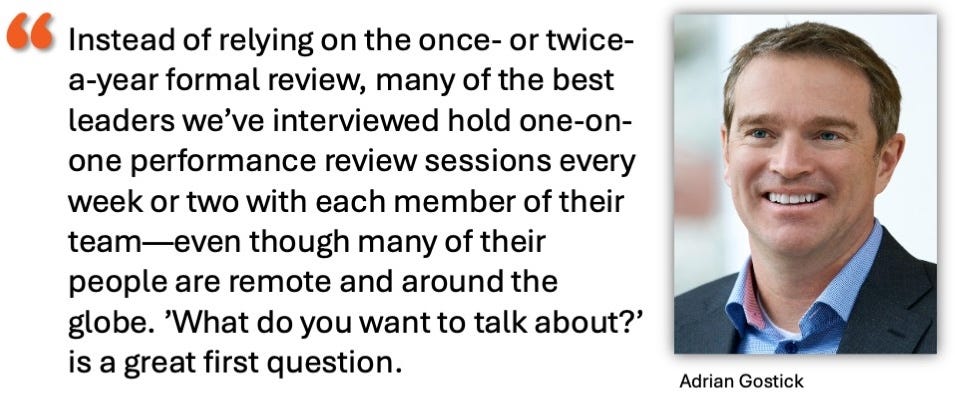
Gostick: Instead of relying on the once- or twice-a-year formal review, many of the best leaders we’ve interviewed hold one-on-one performance review sessions every week or two with each member of their team—even though many of their people are remote and around the globe. “’What do you want to talk about?’ is a great first question.
Many prominent firms have decided to either substantially alter the annual performance review or to abandon the practice entirely—replacing it with other processes for evaluating and developing employees that are more timely, frequent, and in the control of the immediate supervisor. We call this the continuous review. The biggest reason for the change: In today’s fast-moving business environment, a yearly (or half-yearly, for that matter) appraisal is simply not responsive enough to address changes that teams are facing and help people respond.
People need much more regular feedback and guidance—especially younger workers who are unwilling to wait an entire year to learn about their strengths or needed-improvement areas.
Duncan: The culture manifesto at Netflix is often referred to by people wanting to build a high-performing organization. One section of that manifesto says this—“On a dream team, there are no ‘brilliant jerks.’ The cost to teamwork is just too high. Our view is that brilliant people are also capable of decent human interactions, and we insist upon that.” What can leaders do to operationalize that philosophy when forming and managing their teams?
Gostick: Terrific question. One CEO we interviewed told us his company’s number one salesperson had just been let go because he had been found to be sexually harassing female staff members. As the CEO told us, “While you may pay top performers differently and reward them differently, the rules have to apply to everyone exactly the same.” Many organizations might try to sweep his actions under the rug because he was such a high performer, but the CEO said: “How long would that have taken to get out? A few days at most. And it would have given our company a black eye. There are no secrets in an organization.”
Duncan: One of the disciplines you recommend for leaders is “manage the one.” What does that look like in actual practice?
