


By Rodger Dean Duncan
We live in a world where work is regarded as morally worthy. For some, in fact, being a workaholic is considered a badge of honor.
Of course work is important. It’s an engine that keeps the economy and our society moving. It’s how we use our gifts for the benefit of others. It’s how we support our families and how we turn dreams into reality. Without hard work, it’s been said, nothing grows but weeds.
But it’s easy to over do a good thing. In one way or another, most people struggle with that time-honored goal called balance.
Dr. Stewart Friedman, an emeritus professor at the University of Pennsylvania’s Wharton School of Business, has invested his career in studying leadership and the behaviors that make it effective (or not).
Many people, he notes, feel energized by their work, are engaged in it and find it extremely rewarding to serve others. But when they invest disproportionate attention to work they eventually pay a steep price in other areas of their lives.
In addition to (and as a result of) his decades of academic work, Friedman is author of two bestselling books—Total Leadership: Be a Better Leader, Have a Richer Life and Leading the Life You Want: Skills for Integrating Work and Life.
Friedman says a starting point to living a richer life is to rethink how you define success. If your self-worth revolves around the status, paycheck, and prestige associated with your work, you’re headed for trouble. A richer life also takes into account the quality of your relationships, your engagement in the community, and your physical, emotional, and spiritual well-being.
I reached out to Friedman to explore his research-based approach to enjoying what he calls “four-way wins”—better results at work, at home, in the community and for your self.
Rodger Dean Duncan: You address personal development in the context of four interdependent domains—work, home, community, and self. Many people seem to think that success in one domain must come at the expense of one or more of the others. You call “work/life balance” the wrong metaphor. Why?
Stewart Friedman: “Balance” is a misguided metaphor because it conveys the idea that we have to give up the prospect of success in one part of our lives in order to have it in another part—one or the other.
When we think this way we’re likely to end up making more sacrifices than necessary. If instead we pursue the prospect of harmony among the different parts of life—like the instruments in a jazz quartet trying to make good music—then the possibilities for wellbeing and high performance are much greater.
This is what our research and practice show: Consciously and deliberately aiming for what I call “four-way wins”—improved performance at work, at home, in the community, and for the private self (mind, body, and spirit)—leads to smarter use of time, stronger relationships with people who matter most, less distraction and more focused effort, and better results. It’s not possible to have it all in balance, all at once. But our research shows that over the course of time it is possible to have a greater sense of peace and harmony.
Duncan: A major premise of your approach to personal effectiveness is that leadership skill is required to manage the boundaries between different areas of one’s life. How do you help people understand that—even if they lack a title or position generally associated with “leadership”—they need to develop specific skills to lead their own lives?
Friedman: Leadership is about mobilizing people toward valued goals, envisioning a better future and inspiring people to move there with you. You can be a great leader and have no one reporting to you in an organizational hierarchy. Conversely, you can have lots of people under you and be a terrible leader.
So it’s not as much about executive authority as it is about what it takes to clarify what’s important, recognize and respect the whole person, and continually experiment with how things get done. That’s the focus of leadership from the point of view of the whole person.
What I’ve found is that these leadership skills—which anyone can develop and which apply at all stages of our lives and careers—are key to creating harmony among, and good performance in, the different parts of life.
Duncan: You say a key to better leadership and a richer life lies in three practices—Be Real (act with authenticity), Be Whole (act with integrity), and Be Innovative (act with creativity). Why these particular practices?
Friedman: These three principles derive from extensive research we did at the Wharton Work/Life Integration Project on how the people who excel in leading the lives they want actually do it.
When I had the opportunity years ago, as global head of leadership development for Ford Motor Company, to design a new model for how to cultivate leadership capacity, our team created a program for bringing these three principles to life. We called it Total Leadership to signify that leadership isn’t just about business, it’s about life.
Participants did a series of exercises, starting with those that required them to identify their core values, share the stories of critical episodes in their lives that shaped them, and describe a compelling image of their future. They considered the people who mattered most to them and then talked to them to clarify expectations. Then they designed and implemented experiments intended to produce demonstrably improved results in all parts of their lives.
Finally, they reflected on what they learned about how to create change that’s truly sustainable—built to last because these changes serve the interests of people who matter not just at work, not just at home, not just in the community, and not just for the self, but for all key stakeholders.
Duncan: In your model, how does integrity affect a person’s relationships with self as well as with others?
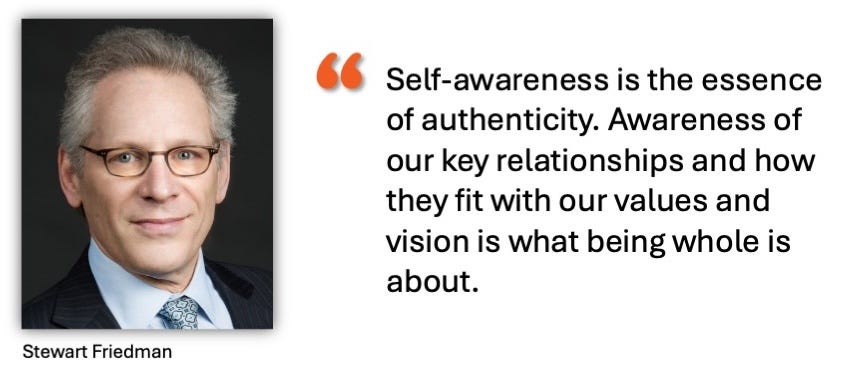
Friedman: Self-awareness is the essence of authenticity. Awareness of our key relationships and how they fit with our values and vision is what being whole is about.
The Latin root of the word “integrity” is one—a whole that fits together, that has coherence. So, to live with integrity is to seek harmony among the different parts of our lives.
In order to do so, we must
clarify mutual expectations with people in our various life roles
build supportive networks at work and throughout our lives
help others
intelligently manage boundaries among roles intelligently
apply the resources we develop in one part of life to goals we’re pursuing in other parts, and
weave the disparate strands together to form a strong fabric.
Duncan: What role does innovation play in personal leadership, and how does it help produce harmony between work, home, community, and self?
