


By Rodger Dean Duncan
You may be familiar with Peter Drucker’s assertion that management is doing things right and leadership is doing the right things.
According to Drucker’s view, you might say that a manager makes sure you climb a ladder efficiently while a leader makes sure your ladder is leaning against the right wall.
These are succinct definitions, but of course in reality the roles often overlap. Some managers are very good at helping people catch the vision of what’s possible, while some leaders are equally adept at making sure day-to-day deliverables are properly handled.
Still, in most organizations there’s a clear distinction between the roles of managers and leaders. And despite the many workplace paradigm shifts that occurred during the Covid pandemic, the view persists that career advancement requires a move from manager to leader.
Adam Bryant offers a cogent analysis of the subject. He’s the creator and former author of the iconic Corner Office column in The New York Times, and is now senior managing director at The ExCo Group, a leadership development and executive mentoring firm. Based on his work with hundreds of successful CEOs and fast-rising executives, Bryant has distilled his key insights into The Leap to Leader: How Ambitious Managers Make the Jump to Leadership.
What questions should people be asking themselves if they think they’d like to move into a leadership role?
“They should invest the time to think about why they want to lead others because these roles are often much harder than they appear,” Bryant says. “As a leader, you’re dealing with a lot of people problems and you’re putting out a lot of fires. Because it’s hard to get work done at work, you’re often facing a three-shift day and the work will bleed into weekends.”
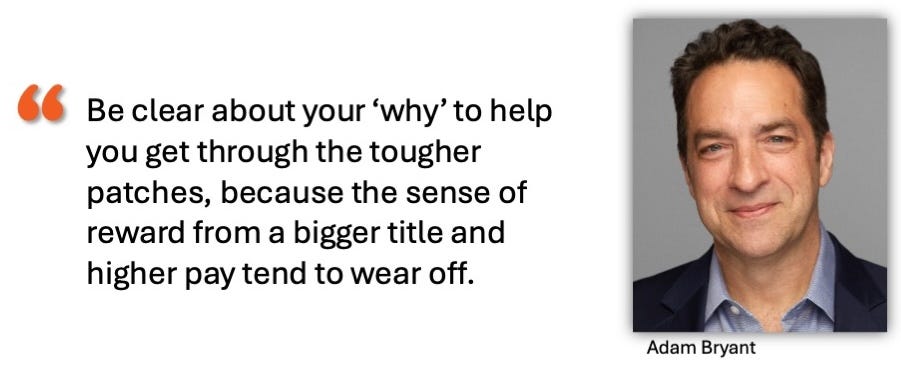
Too often, Bryant says, “people can get enticed by a bigger title and the financial rewards that come with it rather than pausing and asking themselves if they really want to do the work that the job entails. Similarly, companies, when they are looking at their leadership pipeline and succession plans, too often just assume that every person wants to move up. So be clear about your ‘why’ to help you get through the tougher patches, because the sense of reward from a bigger title and higher pay tend to wear off.”
Bryant says the biggest challenge for people who make the leap to leadership roles is the mindset shift they’re required to make. “As a manager, there’s usually an explicit outcome that you are expected to deliver,” he says. “You’re given resources such as time, manpower and a budget to execute the plan. As a leader, you have to think more broadly about opportunities and what the organization needs that maybe other leaders haven’t considered. Doing that requires courage, and a willingness to take bets and own the consequences if things go wrong.”
Bryant says “selfless versus self-centered” is the central paradox facing leaders.
“Leaders who are more selfless think first about the people they are leading and the organization,” Bryant says. “What’s best for the people? They see their role more in terms of coaching people to unlock and develop their skills.”
One of the paradoxes of leadership, Bryant says, is that the role is simultaneously about you and not about you. “Yes, you set the tone and direction as the leader, and all the signals you send—verbal and nonverbal—will carry an outsized impact. But the role isn’t about you.”
Bryant quotes Christian Klein, the CEO of software company SAP, who said, “For me, what’s important is that I’m able, when I look at myself in the mirror in the morning, to answer the question, ‘Is what we are doing absolutely the right thing to do in the midterm and the long term?’ And as long as I can answer that question by saying yes, I know that I’m doing the right thing for all stakeholders.”
Some managers seem to assume that a Starbucks coffee card is the best (certainly one of the easiest) ways to recognize employee performance. What forms of recognition has Bryant found to be most helpful in reinforcing good performance?
