


By Rodger Dean Duncan
As we all try to endure the scorched earth rhetoric of politicians, an age-old question continues to beg for an answer: What’s the most effective way to win the hearts and minds of people?
I can’t speak for you, but I don’t respond well to “shame talk”—as in “Shame on you for holding that particular view.” I also reject name-calling and other forms of incivility.
Call me old-fashioned, but I prefer polite logic and reasoning, backed up by verifiable information, seasoned by a dash of empathy. For me, shallow slogans and in-your-face sound bites are a total turn off.
Most people can smell manipulation, and they don’t respond well to the aroma. Influence and persuasion, on the other hand, often have more subtle nuances.
A thoughtful exploration of the subject can be found in the work of Jocelyn Davis, an internationally known consultant and former head of R&D for The Forum Corporation, a global leadership development firm. She’s author The Art of Quiet Influence: Wisdom and Mindfulness for Work and Life.
Drawing on the enduring wisdom of Buddha, Confucius, Rumi, Gandhi and others, Davis shows how anyone—not just people with titles—can get important things done by using influence without authority.
Rodger Dean Duncan: How do you differentiate between influence and persuasion?
Jocelyn Davis: Persuasion is pressuring someone to do what you want them to do—never mind what they want. It’s about getting your way. Influence, as I define it, is about working with others to co-create a new way, our way.
One of my favorite examples of influence comes from the tennis world. At a tournament in 1979, the champions Björn Borg and John McEnroe were facing off against each other. McEnroe was already infamous for his on-court tantrums, and he was acting up as usual: flinging his racket, yelling, abusing the officials. It was 5-5 in the final set when Borg beckoned him to the net. McEnroe thought Borg was going to rebuke him, but instead Borg put an arm around his shoulders and said, “It’s OK. Just relax. It’s OK. It’s a great match.”
McEnroe later said it was a turning point in his career. At that moment, he said, he realized “if we could keep lifting our games, I didn’t have to worry about the crowd or the linesmen or anything.” To this day he refers to Borg as his “great” rival.
Great influencers don’t push or pull or manipulate. Instead, they help all of us lift our game.
Duncan: Authority is clearly not the same as power. How can someone without authority or title exert influence with other people?
Davis: Authority and power often overlap, but they’re two different things. Some leaders have lots of formal authority—a big title—but little real power, because they’re unable to mobilize people. Other leaders have real power despite a lack of formal authority; they know how to get things done with and through others, title or no title.
Carin Gendell, a colleague who teaches influence workshops, says too many team leaders obsess over their lack of authority. They spend all their time trying to get someone to grant them decision rights, or the right to control who’s on the team, or a bigger budget. She tells them, “Stop arguing for positional authority and instead start making things happen on the team. Because when the team performs, you’re more likely to win the authority.”
And that’s really the key to influence: shift your focus away from the authority you may or may not have and toward making things happen. But “making things happen” isn’t the best way to put it, because it’s not about cracking the whip. I talk about three core influence practices: invite participation, share power, and aid progress. These three practices are the key to exerting influence without authority.
Duncan: You draw upon the thinking of twelve “sages” whose thinking on influence dates back through many centuries. How did you select these twelve people and what common themes do you see in their philosophies that are relevant today?
Davis: These sages represent the classic wisdom of the East: China, India, Japan, and the Islamic world. Of the twelve, Confucius, the Buddha, Rumi, and Gandhi are probably the best known. Some readers will recognize Dogen, the father of mindfulness meditation. Many know Zhuangzi, one of the founders of Taoism. The others are mostly unknown in the West, but renowned in their own cultures.
They come from various thought traditions. Scholars may be horrified that I’ve lumped them together! And I don’t make the mistake of regarding Eastern cultures as more inherently peaceful or “nice” than Western ones; many Eastern leaders match their Western counterparts in political ambition and ruthlessness.
I selected them for two reasons. First, research shows the Eastern perspective is less atomistic than the Western one. For these thinkers, a leader’s job is to channel the world’s natural flow rather than push things around; hence, they have a lot to say about quiet influence—strength without force. Second, they were all mavericks: marginalized or ignored by the establishment of their time and rediscovered centuries later by seekers of a better way. They weren’t perfect people, but their writings are troves of insight and fresh ideas.
Duncan: One influence behavior you recommend is to encourage others to express objections and doubts. Why do many people seem to miss that lesson, and what do you think is the cost to their relationships?
Davis: Most of us, when we hear an objection—someone says, “I don’t agree,” or “I don’t want to,” or “I hate that idea”—immediately get busy explaining why we’re right and they’re wrong. We want to overcome the objection, to beat it down. It’s our reptilian brain responding to a perceived attack. And, the other person usually responds in kind: they fight back, dig in their heels, or simply withdraw. Once both parties are in fight-or-flight mode, influence is impossible. Even a relationship can be impossible.
The way to counteract the reptile-brain response is to see objections not as pushback, but as a sign of engagement. It’s a precept taught in every sales training class: the customer who sits there nodding and smiling—“Sure, sounds good”—is less likely to buy than the customer who says, “The price is too high, I don’t like the color, what if it breaks?” The second customer is engaged. The first doesn’t care.
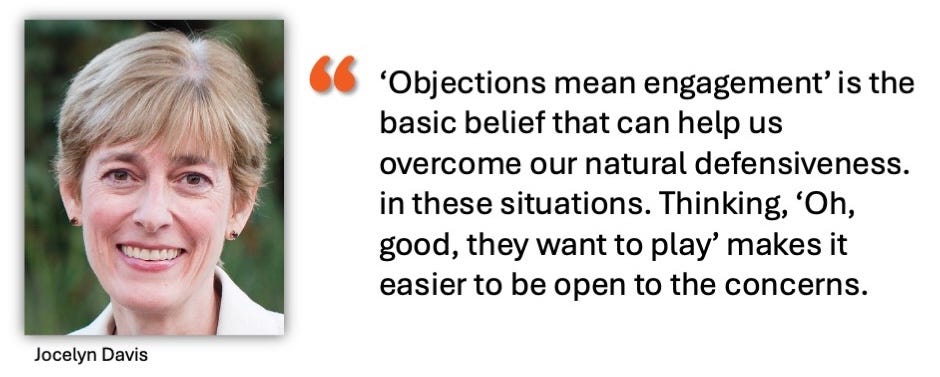
“Objections mean engagement” is the basic belief that can help us overcome our natural defensiveness in these situations. Thinking, “Oh, good, they want to play” makes it easier to be open to the concerns.
Duncan: Another influence practice you suggest is to take time to develop a shared outlook. That seems to fly in the face of today’s highly partisan approaches to public discourse. What are some good models of developing a shared outlook that you’ve seen, and what can be learned from those models?
Davis: Influence practices—please note!—won’t work with strangers on the internet. If you want an influence relationship, you need a relationship. With strangers or crowds, you can use rhetoric. When it comes to getting stuff done with associates, over time—that’s when you use influence.
My favorite model for developing a shared outlook is called the Hassle Graph (the brainchild of my colleague Andre Alphonso). On the vertical axis is hassle; on the horizontal axis is time. Typically a project starts off low on hassle—everyone’s into it, things hum—but later, when you really want to be making progress, hassle increases. The answer is to move some of the hassle up front, by discussing roles, ground rules, and simply getting to know one another. In other words, you need to front-load the hassle so the line goes down over time instead of up.
Frankly, it doesn’t matter which specific techniques you use. What’s important is the time and effort you invest early on to create a real group: one where people feel welcomed and integral rather than overlooked and dispensable. That investment, though it feels like a hassle, has huge payoffs in performance down the road.
Duncan: One problem in our modern society is that people learn about those who hold different views but they seldom make the effort to learn from them. Many people then become information rich but understanding impoverished. How can that trap be avoided?
