


By Rodger Dean Duncan
My friend Tom Pulliam was a modern-day Renaissance man. He had multiple careers, sometimes overlapping, because he learned how to shape his gifts to match the needs of others.
For many years, Tom worked as a manager at a food manufacturing company in Oklahoma City. He made lunchmeat. In his off-hours he liked to do crossword puzzles. He got very good at it. So good, in fact, that when he ran out of puzzles to solve he started creating his own. Then he got so skilled at creating new puzzles that he began to sell them. That was decades ago. Today, if you want one of the best books on the subject, pick up a copy of The New York Times Crossword Puzzle Dictionary—by Tom Pulliam.
Oh, yes, Tom also made a name (and a fortune) for himself as an actor, doing voiceovers for a wide range of TV and radio commercials.
Tom would insist that he was no smarter than the next guy. Maybe not, but he definitely took a cue from Albert Einstein, who advised that we should live out of our imagination rather than out of our memory. Tom’s sound thinking enabled him to discover opportunities that enriched both his life and his bank account.
That kind of thinking is at the heart of Dorie Clark’s book Reinventing You: Define Your Brand, Imagine Your Future. Dorie, who teaches at Duke University’s Fuqua School of Business and consults on marketing strategy, was described by the New York Times as “an expert at self-reinvention and helping others make changes in their lives.” She’s also author of Stand Out: How to Find Your Breakthrough Idea and Build a Following Around It.
I visited with Dorie about a number of issues faced by people considering work and career changes.
Rodger Dean Duncan: A first step in professional reinvention is getting clarity on where you currently are. What are the steps to a “personal brand inventory” to provide that clarity?
Dorie Clark: First, it’s not a bad idea to Google yourself to see what comes up. Then set a Google Alert so that in the future you’re notified when your name is mentioned online. That way you can be aware of what’s out there, thank people if they’re saying something nice, and correct the record if they’re saying something incorrect. Your Google search results provide a clue to what people who don’t know you well will think when they start to research you. If you’ve written a number of thoughtful blog posts about your profession, that sends one message, and if the results for your name are random and scattered, that sends another.
Next, I suggest a quick exercise that can enable you to quickly understand what the people directly around you think about your brand. It’s called the “3 Word Exercise” and it involves asking about a half-dozen friends and colleagues to describe you in only three words. This forces them to boil down their perceptions and identify what’s most important—which gives you an important clue as to what is seen as most distinctive about you, and strengths you can build on.
Duncan: In evaluating personal passions and possibilities, what are some good ways to enlist others to help you focus on a promising future?
Clark: When you’re in the discovery stage and are trying to figure out what you want to do (or do next) professionally, it’s important to gather “data points” to determine whether the career possibilities you imagine match the reality. It’s easy to fantasize about running your own bakery and creating innovative, delicious treats. It’s another thing altogether to get up at 3 o’clock in the morning to bake bread every day.
Try to gather at least 5-10 data points for each job or profession you’re considering. These could include informational interviews with friends or friends-of-friends, reading memoirs of people in the profession, attending conferences for that profession to see what’s being talked about, etc.
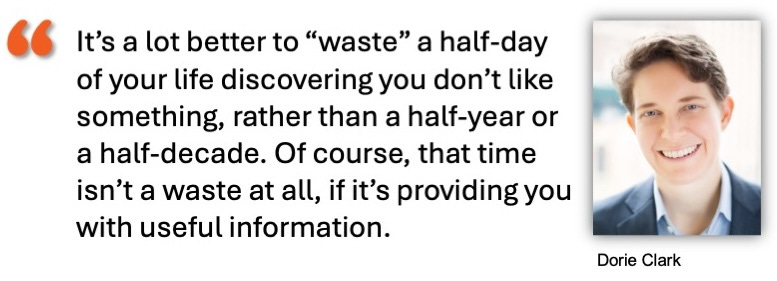
Something that’s uniquely valuable, if possible, is to spend time job shadowing someone—i.e., following them around for a day or so and seeing what their life is really like. Very few people do this because they worry it seems invasive or awkward—and certainly, it would be more difficult if the person is extremely high ranking, or works inside a large corporation and would need to get permission from others. But especially for entrepreneurs or those who have more autonomy, it can be a flattering request that shows real interest in their work, provided you have a close enough connection to them that it doesn’t seem like a random request from a stranger.
Duncan: You recommend “test driving” a new career direction to ensure it’s really a good fit. How can that be done in a way that avoids a risky detour?
