


By Rodger Dean Duncan
As any good CEO can tell you, successful leadership has many moving parts. Doug Conant, former president and CEO of Campbell’s Soup, put it succinctly: “To win in the marketplace you must first win in the workplace.”
Patrick Thean certainly embraces that principle. He’s a CEO coach and serial entrepreneur. His tools and methods have helped scores of organizations achieve sustainable top performance and have been adopted by educational programs such as Cornell University’s Family Business Initiative. Thean is the CEO and co-founder of Rhythm Systems, an organization that helps CEOs get their teams focused, aligned, and accountable.
His latest book is The Journey to CEO Success: 7 Practices for High Growth Leadership.
In brief, here are the seven practices:
1. Be curious (effective listening accelerates learning)
2. Level up (check for blind spots, be eager for feedback)
3. Establish your early warning systems (if you can’t see a problem, you can’t avoid it)
4. Achieve full alignment (silos are deadly)
5. Make culture your competitive advantage (establish the right environment for success)
6. Build a strong people ecosystem (continually grow and renew team skills)
7. Focus on serving your core customer (identify the primary user of your product or service)
Thean says cultivating a curiosity mindset begins with valuing questions over answers. “Leaders sometimes feel pressured to provide immediate answers, but if we’re genuinely curious, we’ll seek to learn from the experiences and insights of our teams,” he says. “The best ideas come when we open ourselves up to the perspectives of others.”
Feedback is another key ingredient, he says. He encourages leaders to embrace what he calls “spicy conversations”—those candid, sometimes challenging discussions that lead to growth. “Each piece of feedback offers a chance to adapt and improve, building trust within the team and encouraging openness,” he says.
So, what does performance-enhancing curiosity look like in terms of observable habits and behaviors?
Thean says high performers don’t stop at “Why isn’t this working?” They go deeper, asking things like, “What specific factors might be causing this issue? How can we measure those?” Next, they experiment constantly, but with focus. They don’t wait for perfect information. Instead, they run small tests, measure the results, and adjust quickly.
“Top performers also look for insights everywhere, not just in their field,” he says. “They read widely, pull ideas from other industries, and bring in fresh perspectives. This cross-disciplinary curiosity is often where innovation happens, as it allows them to connect dots others miss. Finally, they practice patience and persistence.”
Curiosity, he says, doesn’t always lead to instant answers. “Sometimes it takes weeks, months, or more to crack a tough problem. But high performers keep pushing, keep iterating. They don’t give up just because progress is slow.”
Thean advocates replacing fear with curiosity.
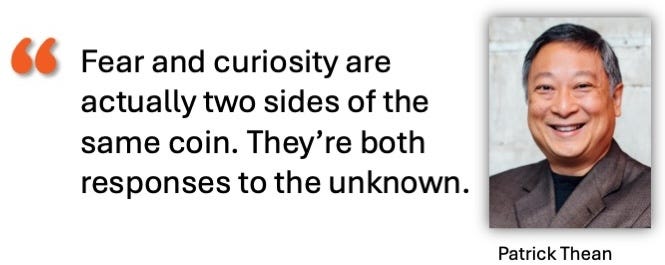
“Fear and curiosity are actually two sides of the same coin,” he says. “They’re both responses to the unknown. We can either let fear take over, which tends to shut us down, or we can lean into curiosity, which opens us up to possibility.”
He offers an example. “If a project isn’t going well, the fear-based response might be to cover up mistakes or blame others. But a curious response would be to ask, ‘What can we learn from this? What went wrong, and what could we do differently next time?’ That kind of thinking moves you forward. It’s constructive.”
Thean tells leaders to actively cultivate curiosity in their teams, because it changes the culture. “When people feel they have permission to explore without fear of punishment, they’re more engaged. They’re willing to take calculated risks, ask better questions, and push the boundaries a bit. Over time, that curiosity-driven culture leads to better performance and innovation.”
What roles do humility and self-awareness play in a person’s aspiration for or success in a leadership position?
