


By Rodger Dean Duncan
If you were to write the job description for “leader,” one of the bullet points would likely be something related to “engagement.” The leader’s responsibility is not to create followers. It’s to create more leaders. This cascading effect is what gets things done. It requires appealing to people’s heads, hearts, and hopes.
While it’s true that self-starting achievers typically don’t need a lot of strokes, giving too little feedback is a common trust buster.
I once heard a so-called leader say “My people should just be grateful to have jobs. If they do something wrong, I’ll let ‘em know. Otherwise, they should just press on. There’s too much work to do to take time with a bunch of back-slapping.”
In that same conversation, this guy wondered aloud why his people didn’t seem very engaged in the work.
It’s been said that feedback is the breakfast of champions. Unfortunately, a lot of the feedback offered in the workplace is a meal worth missing.
Here’s an example. Let’s say you’re talking with Phil about his job performance and you deliver a speech that goes something like this: “Okay, Phil. As you know, we’re raising the bar around here. We need to get more out of you this coming year. It seems like you’re not really stretching, and you need to stretch. You’re definitely in the ‘Needs Improvement’ category, and we need you to step up to the ‘Meets Expectations’ slot. So get out there and show us what you can do.”
That little speech may sound like something from a Saturday Night Live skit, but it’s virtually verbatim from the kind of drivel that some people try to pass off as helpful feedback.
If you’re the Phil in that scenario, you’ll likely go home and tell your wife: “I don’t know what those people expect of me. I’m already working my tail off and all they tell me is that I need to ‘stretch.’ What’s that’s supposed to mean?”
Frustrating? Yes. Does feedback need to be an unpleasant, even harmful experience? Absolutely not.
Tamra Chandler offers some great tips on how to help people grow and develop through insightful observation and coaching. She’s author of Feedback: Why We Fear It, How to Fix It.
Rodger Dean Duncan: What is it about “feedback” that seems to make many people break out in a cold sweat?
Tamra Chandler: Most of us have been conditioned—through bad experiences that start in our youth and continue throughout our lives—to expect feedback to hurt. This conditioning creates connections in our brains that trigger our “fight or flight” reactions when presented with feedback.
When we look closely at what really frightens us about feedback, it boils down to this: identity and connection. At the heart of our fear is our identity, and how that identity is shaped and reinforced by our connections to and affiliations with the rest of the world. Humans are social beings; we instinctively want to be included and valued. The need to stay connected with and accepted by our communities drives our actions without our intellectual complicity. In the end, this desire for belonging gets seriously in the way of giving and receiving feedback.
Duncan: When people are struggling with “ghosts of feedback past,” how can a leader help them shift to a more pro-feedback perspective?
Chandler: We need to wipe the slate clean and start anew. Our first step is to redefine feedback to support our true intent and desired outcomes. We propose this new definition—
Feedback (NOUN): Clear and specific information that’s sought or extended for the sole intention of helping individuals or groups improve, grow, or advance.
Pay particular attention to “with the sole intention of helping.” Too often in our interactions, the feedback we receive is simply not helpful. If it isn’t intended to help individuals or teams thrive and grow, then why offer it or seek it?
It’s equally important to tune into what’s not in our definition: feedback is not intended as evaluation, blame, or judgment. We see feedback as insight that helps us look forward, to a better version of ourselves, our organization, or our team. Raking our past performance over the coals and attaching an evaluative label to it will not create a better you, me, or us.
Duncan: Everyone seems to favor employee engagement. What role does feedback play in engagement?
Chandler: Feedback gets to the heart of two things employees need to thrive: vitality and learning.
At its simplest level, vitality comes from a strong sense that what we do makes a difference. Learning means we’re building our skills and capabilities while simultaneously boosting our confidence in our potential growth.
It’s not hard to understand the connection between vitality, learning and feedback. Significant drivers of vitality include relationships, connections, recognition, and clarity—all outcomes of healthy, ongoing feedback conversations. Learning is the result of insights we gain that help us improve, expand, and advance –outcomes of trusted and specific feedback relevant to our growth.
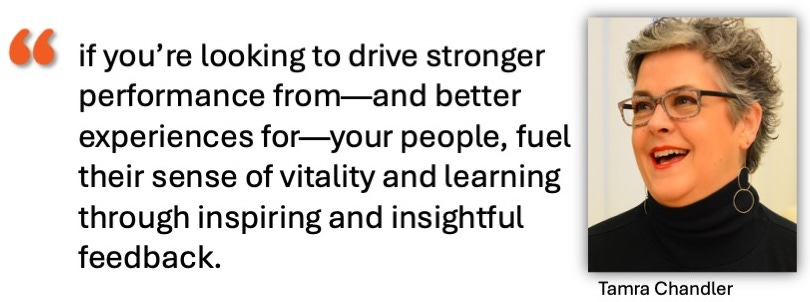
So, if you’re looking to drive stronger performance from—and better experiences for—your people, fuel their sense of vitality and learning through inspiring and insightful feedback.
Duncan: Stanford psychologist Carol Dweck has done years of research on mindset, which she describes as a self-perception of self-theory. How does mindset affect people’s resistance to—or effective use of—feedback?
Chandler: Mindset is a key factor in influencing our potential to grow and improve. Dweck coined the terms “fixed mindset” and “growth mindset”. People with a fixed mindset believe that their intelligence and talent are fixed, that talent alone creates success. People with a growth mindset believe their talents and abilities can develop with hard work—they believe growth and improvement can happen.
When managers and organizational cultures adopt a growth mindset, people are more willing to ask questions, venture ideas, embrace challenges and focus on progress over perfection. To use feedback effectively as a catalyst to change, shift, grow and improve, both extenders and receivers of feedback need to operate from a growth mindset.
Duncan: Every great feedback experience, you say, is anchored in fairness, focus, and frequency. Please elaborate.
